A soldier loses his way in a thick jungle and walks at random from his camp,…
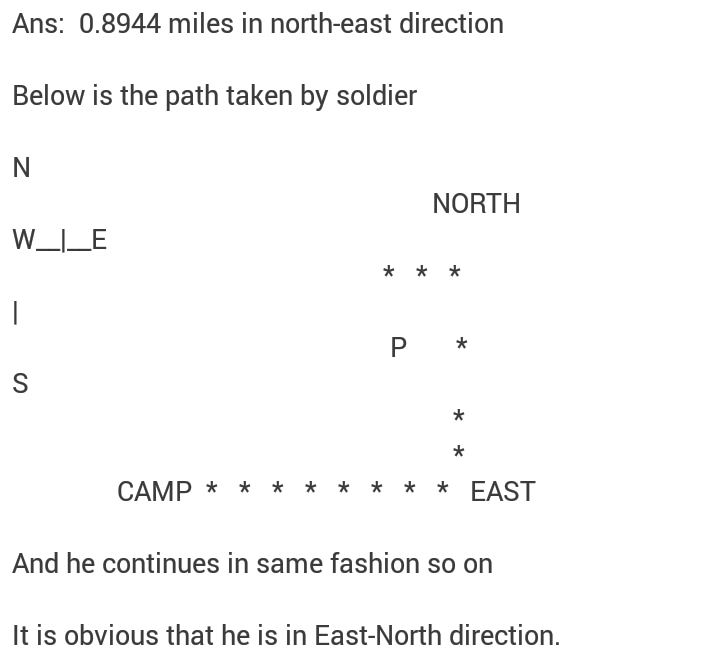
A soldier loses his way in a thick jungle and walks at random from his camp, but mathematically in an interesting fashion. First he walks one mile to the east, then half a mile to the north, then 1/4 mile to the west, then 1/8 mile to the south, and so on, looping around like this. Finally, how far is he from his camp, and in which direction?
Answer: A. 0.8944 miles in north-east direction — Concept: An infinite geometric series with first term a and common ratio r (|r| < 1) converges to a/(1 - r). When a path reverses direction every step while…
- A.
0.8944 miles in north-east direction
- B.
0.8944 miles in south-east direction
- C.
0.7944 miles in north-east direction
- D.
0.7944 miles in south-east direction
Attempted by 2 students.
Show answer & explanation
Correct answer: A
Concept: An infinite geometric series with first term a and common ratio r (|r| < 1) converges to a/(1 - r). When a path reverses direction every step while each successive leg is half of the leg before it, the net displacement along each axis is exactly this kind of alternating (negative-ratio) geometric series, and the two perpendicular net displacements combine into one resultant distance and bearing via the Pythagorean theorem.
Application:
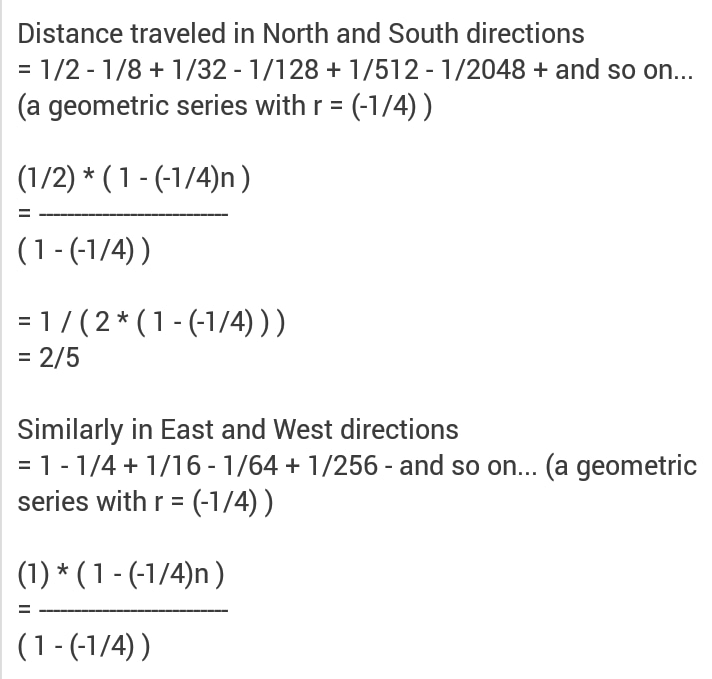
List the walk in order: East 1, North 1/2, West 1/4, South 1/8, East 1/16, North 1/32, West 1/64, South 1/128, and so on — each leg is half the length of the leg immediately before it, so along a single axis (every second leg) the ratio between successive same-axis legs is 1/4.
Group the East and West legs (East positive): 1 − 1/4 + 1/16 − 1/64 + ... — a geometric series with first term a = 1 and common ratio r = −1/4.
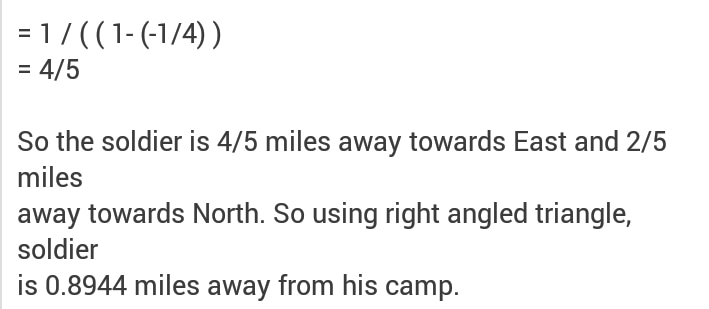
Apply a/(1−r): East-West net = 1 / (1 − (−1/4)) = 1 / (5/4) = 4/5 mile, i.e. 4/5 mile net to the East.
Group the North and South legs (North positive): 1/2 − 1/8 + 1/32 − 1/128 + ... — again a geometric series with a = 1/2 and r = −1/4.
Apply a/(1−r): North-South net = (1/2) / (5/4) = 2/5 mile, i.e. 2/5 mile net to the North.
The two net components, 4/5 mile East and 2/5 mile North, are perpendicular, so the straight-line distance from the camp is √((4/5)2 + (2/5)2) = √(16/25 + 4/25) = √(20/25) = √(4/5) = 2/√5 ≈ 0.8944 mile.
Since the East component and the North component are both positive, the resultant lies in the North-East quadrant relative to the camp.
Cross-check: Verify the bearing independently: tanθ = (North component)/(East component) = (2/5)/(4/5) = 1/2, so θ ≈ 26.57° measured from the East axis toward North — a small acute angle, consistent with a resultant closer to due East than due North, matching the shape of the spiral (each East/West leg is twice the paired North/South leg). This confirms both the magnitude (≈ 0.8944 mile) and the quadrant (North-East) found above.
Reference working: