To obtain figure (b) from figure (a) in a binary system, which modulation…
2021
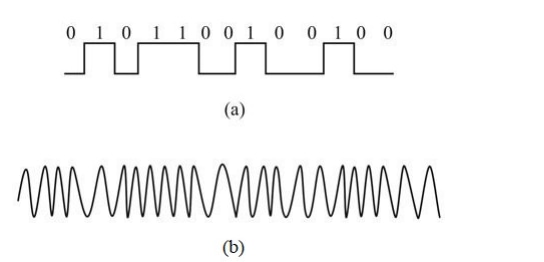
To obtain figure (b) from figure (a) in a binary system, which modulation technique is applied?
Answer: B. Frequency modulation — Concept. A sinusoidal carrier is completely described by three independent parameters: its amplitude (the peak height of every crest), its frequency (the…
- A.
Amplitude modulation
- B.
Frequency modulation
- C.
Phase modulation
- D.
Quadrature phase shift keying
Attempted by 1217 students.
Show answer & explanation
Correct answer: B
Concept. A sinusoidal carrier is completely described by three independent parameters: its amplitude (the peak height of every crest), its frequency (the number of cycles per second, seen as how tightly the cycles are packed) and its phase (the starting angle of the wave). Modulation means holding two of these parameters fixed and letting the message vary the third, and every modulation technique is named after the parameter it is allowed to change. When the message is a binary signal, that one parameter simply switches between two fixed values, one assigned to bit 0 and the other to bit 1.
Application to this item
Read the upper trace, labelled (a). It is a two-level NRZ digital signal annotated with the bit pattern 0 1 0 1 1 0 0 1 0 0 1 0 0: it sits at the low level for every 0 and at the high level for every 1. This is the message, not the carrier.
Now read the peak height of the lower trace, labelled (b). Every crest rises to the same height and every trough falls to the same depth from one end of the trace to the other, so the amplitude parameter has not been touched at all.
Next read the cycle spacing of that same lower trace. Over the stretches that line up with a 1 the cycles are packed close together, which is a short period and therefore a high frequency; over the stretches that line up with a 0 they are spread wider apart, which is a long period and therefore a low frequency.
The wave also runs on continuously with no abrupt reversal, so the phase parameter has not been switched either. One parameter alone is being driven by the bits, and it is the frequency, so by the concept above the technique is frequency modulation. Its binary special case has the specific name frequency-shift keying (FSK).
Cross-check against the other techniques
Technique | Carrier parameter varied | How the carrier would then look |
|---|---|---|
Amplitude modulation (digital form: ASK) | Amplitude | Crest height changes with the bits, tall for one bit value and short or absent for the other, while the cycle spacing stays the same throughout |
Frequency modulation (digital form: FSK) | Frequency | Crest height stays the same throughout, while the cycles are packed closer for one bit value and spread wider for the other |
Phase modulation (digital form: BPSK) | Phase | Crest height and cycle spacing both stay the same, while the wave reverses direction abruptly at every change of bit value |
Quadrature phase shift keying | Phase, four values | Crest height and cycle spacing both stay the same, while the bits are grouped in pairs and each pair is sent as one of four phase angles |
Only the frequency row reproduces the constant-height, varying-spacing picture that is actually drawn in the lower trace, so the carrier there is a frequency-modulated version of the digital signal above it.