The process state transition diagram of an operating system is as given below.…
2006
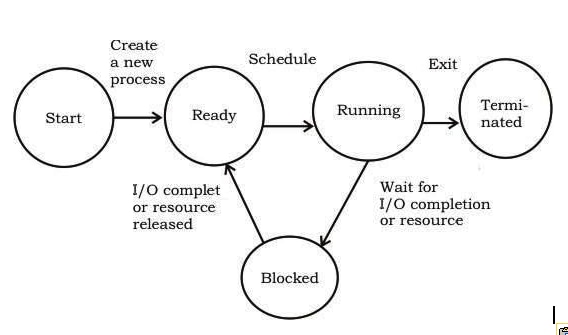
The process state transition diagram of an operating system is as given below.
Which of the following must be FALSE about the above operating system?
Answer: B. It uses preemptive scheduling — A process state-transition diagram distinguishes preemptive from non-preemptive scheduling by whether it contains a scheduler-driven transition from Running…
- A.
It is a multiprogrammed operating system
- B.
It uses preemptive scheduling
- C.
It uses non-preemptive scheduling
- D.
It is a multi-user operating system
Attempted by 910 students.
Show answer & explanation
Correct answer: B
A process state-transition diagram distinguishes preemptive from non-preemptive scheduling by whether it contains a scheduler-driven transition from Running back to Ready (for example, on a timer/time-slice expiry). If the only ways to leave Running are the processs own actions — blocking for I/O or a resource, or terminating — the scheduling shown is non-preemptive. Multiprogramming and the number of users are separate properties: multiprogramming is read off whether more than one process can be resident at once (via queued states such as Ready/Blocked), while the user count is not encoded by a process-state diagram at all.
The diagrams states and transitions are: Start → Ready ("Create a new process"), Ready → Running ("Schedule"), Running → Terminated ("Exit"), Running → Blocked ("Wait for I/O completion or resource"), and Blocked → Ready ("I/O complete or resource released").
List every transition that leaves the Running state: only two are drawn — Running → Terminated and Running → Blocked. Both are triggered by the process itself (it finishes, or it asks to wait).
No Running → Ready arc is drawn anywhere in the diagram, so no timer/scheduler event is shown forcing a running process back to Ready.
By the rule above, the absence of that scheduler-forced Running → Ready transition means the depicted scheduling is non-preemptive — so the claim "It uses preemptive scheduling" cannot hold for this system, and it is the statement that must be FALSE.
It uses non-preemptive scheduling — this is exactly the property confirmed by the same absent Running → Ready arc, so this statement is supported by the diagram, not falsified by it.
It is a multiprogrammed operating system — a diagram with separate Ready and Blocked states models more than one process able to be resident in memory at once (one running while others wait), which is consistent with multiprogramming; nothing in the diagram rules this out.
It is a multi-user operating system — the number of user accounts or sessions a system supports is not represented by a process-state diagram at all (it models process lifecycle, not user sessions), so this statement is neither confirmed nor contradicted by the figure — it cannot be forced to FALSE either.
Since preemptive scheduling is the only one of the four claims that the diagram actively rules out, "It uses preemptive scheduling" is the statement that must be FALSE — matching GATE 2006 Information Technology’s published official answer key for this question.
A video solution is available for this question — log in and enroll to watch it.
Explore the full course: Iocl Engineers Officers Grade A Paper 2