In a system, there are three types of resources: E, F and G. Four processes…
2018
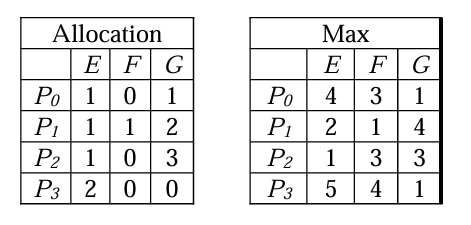
In a system, there are three types of resources: E, F and G. Four processes P0, P1, P2and P3 execute concurrently. At the outset, the processes have declared their maximum resource requirements using a matrix named Max as given below. For example, Max[P2,F] is the maximum number of instances of F that P2 would require. The number of instances of the resources allocated to the various processes at any given state is given by a matrix named Allocation.
Consider a state of the system with the Allocation matrix as shown below, and in which 3 instances of E and 3 instances of F are the only resources available.
From the perspective of deadlock avoidance, which one of the following is true?
Answer: A. The system is in safe state. — Compute Need = Max - Allocation. P0 needs (E=3, F=3, G=0). P1 needs (E=1, F=0, G=2). P2 needs (E=0, F=3, G=0). P3 needs (E=3, F=4, G=1). Initial available…
- A.
The system is in safe state.
- B.
The system is not in safe state, but would be safe if one more instance of E were available.
- C.
The system is not in safe state, but would be safe if one more instance of F were available.
- D.
The system is not in safe state, but would be safe if one more instance of G were available.
Attempted by 122 students.
Show answer & explanation
Correct answer: A
Compute Need = Max - Allocation.
P0 needs (E=3, F=3, G=0).
P1 needs (E=1, F=0, G=2).
P2 needs (E=0, F=3, G=0).
P3 needs (E=3, F=4, G=1).
Initial available resources: (E=3, F=3, G=0).
Find a process whose need is <= available, let it finish, add its allocation to available, and repeat to build a safe sequence.
Choose P0 since its need (3,3,0) <= available (3,3,0). After P0 finishes it releases its allocation (1,0,1). New available = (4,3,1).
Choose P2 since its need (0,3,0) <= available (4,3,1). After P2 finishes it releases (1,0,3). New available = (5,3,4).
Choose P1 since its need (1,0,2) <= available (5,3,4). After P1 finishes it releases (1,1,2). New available = (6,4,6).
Finally P3's need (3,4,1) <= available (6,4,6), so P3 can finish.
All processes can finish in this order, therefore the system is in a safe state. One safe sequence is: P0 → P2 → P1 → P3.
A video solution is available for this question — log in and enroll to watch it.
Explore the full course: Iocl Engineers Officers Grade A Paper 2