Let A be an n × n matrix of the following form. What is the value of the…
2004
Let A be an n × n matrix of the following form.
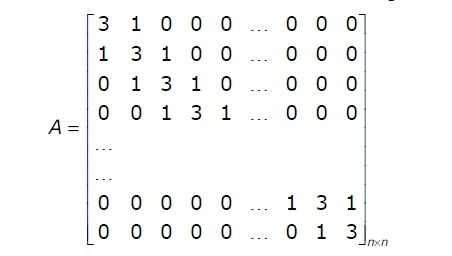
What is the value of the determinant of A?
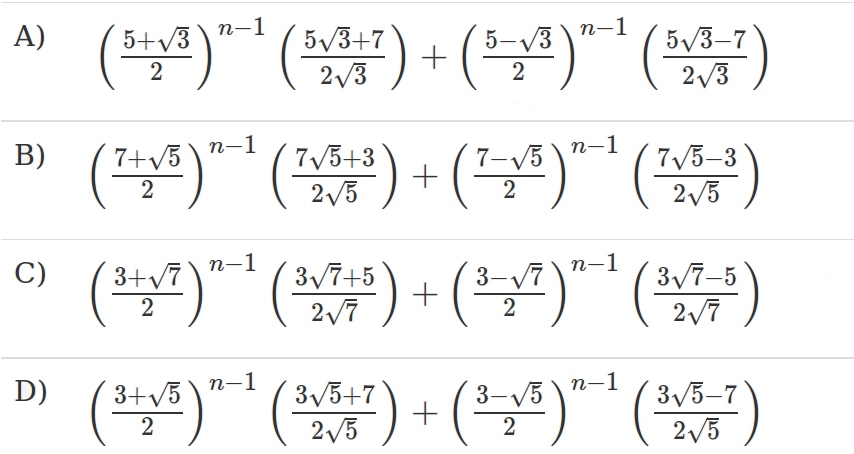
Answer: D. D — For an n×n tridiagonal Toeplitz matrix with diagonal entries a and off-diagonal entries p (upper) and q (lower), cofactor expansion along the first row gives…
- A.
A
- B.
B
- C.
C
- D.
D
Attempted by 19 students.
Show answer & explanation
Correct answer: D
For an n×n tridiagonal Toeplitz matrix with diagonal entries a and off-diagonal entries p (upper) and q (lower), cofactor expansion along the first row gives the determinant recurrence Dn = a*Dn-1 - (p*q)*Dn-2. The characteristic equation of this linear recurrence, r2 - a*r + p*q = 0, has two roots r1, r2, and the closed form is Dn = c1*r1n-1 + c2*r2n-1, where c1 and c2 are fixed using the two initial determinants D1 and D2.
Here a = 3 and p = q = 1, so the recurrence becomes Dn = 3*Dn-1 - Dn-2.
The base values are D1 = 3 (the 1x1 determinant) and D2 = 9 - 1 = 8 (the 2x2 minor with diagonal 3 and off-diagonal 1).
The characteristic equation r2 - 3*r + 1 = 0 gives roots r1 = (3+√5)/2 and r2 = (3-√5)/2.
Writing Dn = c1*((3+√5)/2)n-1 + c2*((3-√5)/2)n-1 and substituting n = 1 and n = 2 gives two equations: c1 + c2 = 3 and c1*(3+√5)/2 + c2*(3-√5)/2 = 8.
Since r1 + r2 = 3 and r1 - r2 = √5, solving the pair of equations gives c1 = (3√5+7)/(2√5) and c2 = (3√5-7)/(2√5).
So Dn = ((3+√5)/2)n-1*(3√5+7)/(2√5) + ((3-√5)/2)n-1*(3√5-7)/(2√5), which is exactly the expression built from base terms (3±√5)/2 with these coefficients.
As an independent check, setting n = 1 makes the exponent 0, so the closed form reduces to c1 + c2 = (3√5+7)/(2√5) + (3√5-7)/(2√5) = 6√5/(2√5) = 3, matching D1 = 3 from the 1x1 minor directly. Setting n = 2 gives c1*r1 + c2*r2, which simplifies to 8, matching D2 = 8 from the 2x2 minor directly.
Explore the full course: Iocl Engineers Officers Grade A Paper 2