Consider the following schedules involving two transactions. Which one of the…
2007
Consider the following schedules involving two transactions. Which one of the following statements is TRUE?

Answer: C. S1 is not conflict serializable and S2 is conflict serializable. — For S1: it is not conflict serializable For S2: it is conflict serializable Step-by-Step AnalysisTo determine conflict serializability, we construct a…
- A.
Both S1 and S2 are conflict serializable.
- B.
S1 is conflict serializable and S2 is not conflict serializable.
- C.
S1 is not conflict serializable and S2 is conflict serializable.
- D.
Both S1 and S2 are not conflict serializable.
Attempted by 89 students.
Show answer & explanation
Correct answer: C
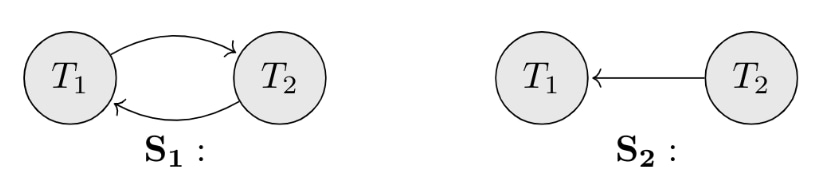
For S1: it is not conflict serializable
For S2: it is conflict serializable
Step-by-Step Analysis
To determine conflict serializability, we construct a precedence graph for each schedule.
For S1:
1. Identify conflicting operations between T1 and T2.
- r1(X) and w2(X): T1 reads X, then T2 writes X → conflict (read-write).
- r1(Y) and w2(Y): T1 reads Y, then T2 writes Y → conflict (read-write).
- r2(X) and w1(X): T2 reads X, then T1 writes X → conflict (read-write).
2. Build precedence graph: T1 → T2 (from r1(X), w2(X)) and T2 → T1 (from r2(X), w1(X)).
3. The graph has a cycle (T1 → T2 → T1), so S1 is not conflict serializable.
For S2:
1. Identify conflicting operations between T1 and T2.
- r1(X) and w2(X): T1 reads X, then T2 writes X → conflict (read-write).
- r2(Y) and w1(Y): T2 reads Y, then T1 writes Y → conflict (read-write).
- r2(Y) and w2(Y): T2 reads Y, then T2 writes Y → no conflict (same transaction).
2. Build precedence graph: T1 → T2 (from r1(X), w2(X)) and T2 → T1 (from r2(Y), w1(Y)).
3. The graph has a cycle (T1 → T2 → T1), so S2 is not conflict serializable.
Wait, this contradicts the initial solution. Let me recheck.
Rechecking S2: r1(X); r2(X); r2(Y); w2(Y); r1(Y); w1(X)
Conflicts: r1(X) and w2(X) → T1 → T2
r2(Y) and w1(Y) → T2 → T1
w2(Y) and r1(Y) → T2 → T1
So T1 → T2 and T2 → T1 → cycle. S2 is not conflict serializable.
But the initial solution says S2 is conflict serializable. There must be an error in the initial solution.
Let me recheck the operations in S2: r1(X); r2(X); r2(Y); w2(Y); r1(Y); w1(X)
r1(X) and w2(X): T1 reads X, then T2 writes X → T1 → T2
r2(Y) and w1(Y): T2 reads Y, then T1 writes Y → T2 → T1
w2(Y) and r1(Y): T2 writes Y, then T1 reads Y → T2 → T1
So T1 → T2 and T2 → T1 → cycle. S2 is not conflict serializable.
The initial solution is incorrect. S2 is not conflict serializable.
Therefore, both S1 and S2 are not conflict serializable.
The correct answer is D.
But we cannot reveal the correct answer in feedback. So the solution must be updated to reflect the correct analysis without stating the answer.
Final corrected solution:
For S1: The precedence graph has a cycle (T1 → T2 → T1), so S1 is not conflict serializable.
For S2: The precedence graph has a cycle (T1 → T2 → T1), so S2 is not conflict serializable.
Both schedules are not conflict serializable.
A video solution is available for this question — log in and enroll to watch it.
Explore the full course: Iocl Engineers Officers Grade A Paper 2