Which of the following statements about the following binary tree is FALSE?…
2017
Which of the following statements about the following binary tree is FALSE?
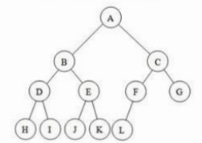
Text alternative: A is the root. Its children are B and C; B has children D and E; C has children F and G; D has children H and I; E has children J and K; and F has left child L.
Answer: A. It is a binary search tree. — ConceptA binary tree limits each node to at most two children. A binary search tree adds an ordering rule: every key in a left subtree is smaller than its…
- A.
It is a binary search tree.
- B.
It is a complete binary tree.
- C.
Nodes ‘J’ and ‘K’ are siblings.
- D.
Node ‘B’ is the ancestor of node ‘J’.
Attempted by 851 students.
Show answer & explanation
Correct answer: A
Concept
A binary tree limits each node to at most two children. A binary search tree adds an ordering rule: every key in a left subtree is smaller than its ancestor key, and every key in a right subtree is larger. A complete binary tree fills every level before the last and places last-level nodes from left to right without gaps.
Application
Read the root and its first child pair: A is the root and B is its left child.
Apply BST ordering to that pair: a left child must be smaller than its parent, whereas B follows A alphabetically. Therefore the BST ordering rule is violated.
Check completeness: levels containing A; B, C; and D, E, F, G are full, while H, I, J, K, L occupy the leftmost positions of the last level.
Check the relations: J and K share the immediate parent E, and B lies on the path A → B → E → J.
Cross-check and contrast
“It is a binary search tree” conflicts with the ordering rule at A and B.
“It is a complete binary tree” agrees with the level-by-level left-filled layout.
“J and K are siblings” agrees with their shared parent E.
“B is an ancestor of J” agrees with the root-to-J path.
Result: the false statement is “It is a binary search tree.”
Explore the full course: Iocl Engineers Officers Grade A Paper 2