When multiplicand Y is multiplied by multiplier X = xn - 1xn-2 ....x0 using…
2006
When multiplicand Y is multiplied by multiplier X = xn - 1xn-2 ....x0 using bit-pair recoding in Booth's algorithm, partial products are generated according to the following table.
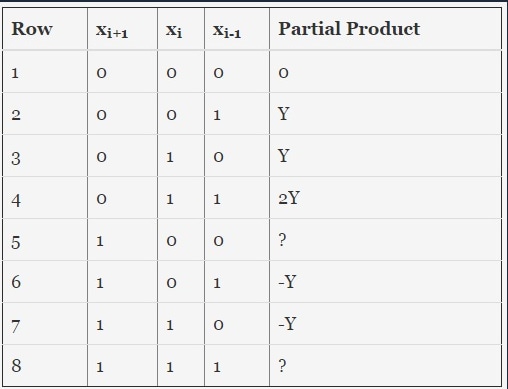
The partial products for rows 5 and 8 are
Answer: C. -2Y and 0 — Concept: Modified Booth's (radix-4) bit-pair recoding groups the multiplier bits into overlapping triplets (xi+1, xi, xi-1); each triplet selects one partial…
- A.
2Y and Y
- B.
-2Y and 2Y
- C.
-2Y and 0
- D.
0 and Y
Attempted by 36 students.
Show answer & explanation
Correct answer: C
Concept: Modified Booth's (radix-4) bit-pair recoding groups the multiplier bits into overlapping triplets (xi+1, xi, xi-1); each triplet selects one partial product using the general rule PP = (−2·xi+1 + xi + xi-1)·Y, where the three bits are read together as a signed digit in {−2, −1, 0, 1, 2}.
General recoding procedure (how to recode ANY multiplier, not just look up a table): write the n-bit two's-complement multiplier as X = xn-1 xn-2 ... x_1 x_0, then append an extra bit x-1 = 0 on the right. If n is odd, sign-extend by repeating the sign bit xn-1 once so the total bit count is even. Now split the bits into overlapping 3-bit groups, moving two bits at a time from the right: group 0 = (x_1, x_0, x-1), group 1 = (x_3, x_2, x_1), group 2 = (x_5, x_4, x_3), and so on. Convert every group to a partial product with the same rule PP = (−2·xi+1 + x_i + xi-1)·Y — this yields one signed partial product per TWO multiplier bits, half as many partial products as ordinary (non-bit-pair) Booth recoding.
Worked example: recode the 4-bit multiplier X = 1 0 1 1 (x_3 x_2 x_1 x_0 = 1, 0, 1, 1). Append x-1 = 0. Group 0 = (x_1, x_0, x-1) = (1, 1, 0): −2(1)+1+0 = −1 → −Y. Group 1 = (x_3, x_2, x_1) = (1, 0, 1): −2(1)+0+1 = −1 → −Y. So X recodes to the partial-product sequence (−Y, −Y), one per bit-pair — exactly the same table-lookup rule used for rows 5 and 8 above.
Application — Check the rule against the rows the table already gives, before using it on the missing rows:
Triplet 0,0,0: −2(0)+0+0 = 0, matching row 1 (0).
Triplet 0,0,1: −2(0)+0+1 = 1, matching row 2 (Y).
Triplet 0,1,0: −2(0)+1+0 = 1, matching row 3 (Y).
Triplet 0,1,1: −2(0)+1+1 = 2, matching row 4 (2Y).
Triplet 1,0,1: −2(1)+0+1 = −1, matching row 6 (−Y).
Triplet 1,1,0: −2(1)+1+0 = −1, matching row 7 (−Y).
The rule reproduces every value the table already shows, so apply it to the two missing rows:
Row 5, triplet (1,0,0): −2(1)+0+0 = −2 → partial product −2Y.
Row 8, triplet (1,1,1): −2(1)+1+1 = 0 → partial product 0.
Cross-check: this matches the standard modified-Booth lookup table, where triplet 100 → −2Y and triplet 111 → 0.
Result: the partial products for rows 5 and 8 are −2Y and 0.
Explore the full course: Iocl Engineers Officers Grade A Paper 2