Consider the following graph: Which one of the following cannot be the…
2006
Consider the following graph:
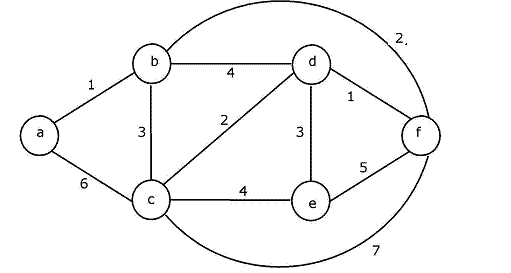
Which one of the following cannot be the sequence of edges added, in that order, to a minimum spanning tree using Kruskal’s algorithm?
Answer: D. (d—f),(a—b),(b—f),(d—e),(d—c) — ConceptKruskal’s algorithm considers graph edges in non-decreasing order of weight. Edges with the same weight may be considered in any order. An edge is…
- A.
(a—b),(d—f),(b—f),(d—c),(d—e)
- B.
(a—b),(d—f),(d—c),(b—f),(d—e)
- C.
(d—f),(a—b),(d—c),(b—f),(d—e)
- D.
(d—f),(a—b),(b—f),(d—e),(d—c)
Attempted by 323 students.
Show answer & explanation
Correct answer: D
Concept
Kruskal’s algorithm considers graph edges in non-decreasing order of weight. Edges with the same weight may be considered in any order.
An edge is added exactly when it joins two different components. Therefore, a lower-weight edge that is still cycle-free must be added before the algorithm reaches any higher-weight edge.
Application
Edge | Weight |
|---|---|
(a—b) | 1 |
(d—f) | 1 |
(b—f) | 2 |
(d—c) | 2 |
(d—e) | 3 |
In the sequence (d—f), (a—b), (b—f), (d—e), (d—c), the first three added edges have weights 1, 1, and 2.
After those three additions, vertex c is not connected to the component containing d, so the weight-2 edge (d—c) would not form a cycle.
Kruskal’s algorithm must therefore add (d—c) while processing weight-2 edges, before it considers the weight-3 edge (d—e).
The proposed sequence instead places (d—e) before (d—c), so it cannot be produced by Kruskal’s algorithm.
Cross-check and contrast
(a—b), (d—f), (b—f), (d—c), (d—e) has weight order 1, 1, 2, 2, 3; equal-weight edges are allowed in this order.
(a—b), (d—f), (d—c), (b—f), (d—e) also has weight order 1, 1, 2, 2, 3; the two weight-2 edges are merely interchanged.
(d—f), (a—b), (d—c), (b—f), (d—e) has weight order 1, 1, 2, 2, 3; the equal-weight edges are again interchanged.
(d—f), (a—b), (b—f), (d—e), (d—c) has weight order 1, 1, 2, 3, 2, which conflicts with the mandatory processing order while (d—c) remains cycle-free.
Result: The sequence (d—f), (a—b), (b—f), (d—e), (d—c) cannot be the order of edges added by Kruskal’s algorithm.
A video solution is available for this question — log in and enroll to watch it.
Explore the full course: Iocl Engineers Officers Grade A Paper 2