Study the diagram given below. Two fully worked chains show how the symbols…
2023
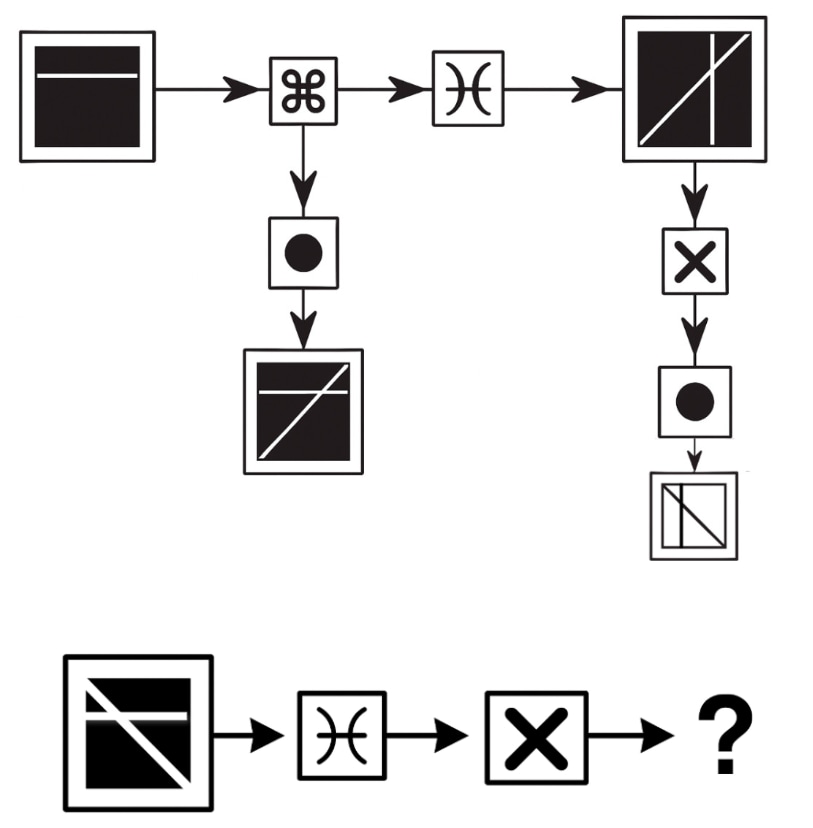
Study the diagram given below. Two fully worked chains show how the symbols (operators) between the figures transform one figure into the next. Using the same rules, select the option that will replace the question mark and complete the incomplete chain shown at the bottom.
Attempted by 54 students.
Show answer & explanation
In a symbol-based figure analogy, each operator icon placed between two figures stands for one fixed visual transformation, such as adding a diagonal in a specific direction, rotating the straight line, flipping the diagonal's direction, or inverting the background colour.
The meaning of each symbol must be read off from the fully worked chains drawn in the diagram, and then applied in the same order to the new starting figure -- every attribute (background colour, line orientation, diagonal direction) has to be tracked exactly, since figures that look broadly similar can still differ in one attribute.
Symbol | Effect on the figure |
|---|---|
⌘ | Adds an ascending diagonal (bottom-left to top-right) to the figure; any existing line and the background colour are left unchanged. |
H | Rotates the figure's straight line by 90 degrees: a horizontal line becomes vertical and a vertical line becomes horizontal; the diagonal and the background colour are left unchanged. |
X | Flips the diagonal's direction (ascending becomes descending, or descending becomes ascending), and inverts the background colour between black and white; the straight line is left unchanged. |
● | Leaves the figure unchanged; the fully worked top chain establishes this directly, since the figure drawn after the diagonal-adding symbol followed by this symbol is identical to what the diagonal-adding symbol alone would give. |
The incomplete chain's starting figure (shown at the bottom of the diagram) has a black background with a horizontal line and a diagonal running from the top-left corner to the bottom-right corner -- a descending diagonal. This is the opposite orientation to the ascending diagonal seen partway along the fully worked top chain, so the two starting points are not the same figure even though both combine a horizontal line with a diagonal on a black background.
Apply the line-rotation symbol (H): the horizontal line rotates to a vertical line, while the descending diagonal and the black background stay unchanged. The figure now has a black background, a vertical line, and a descending diagonal.
Apply the colour-and-diagonal symbol (X): the diagonal flips from descending to ascending, and the background inverts from black to white; the vertical line carries over unchanged. The figure now has a white background, a vertical line, and an ascending diagonal.
This matches the independent worked chain on the right of the diagram in reverse: there, applying the colour-and-diagonal symbol to a figure with an ascending diagonal on a black background produced a white background with a descending diagonal; starting from a descending diagonal instead, the same symbol produces the mirror result -- a white background with an ascending diagonal.
The option with a black background, a vertical line, and an ascending diagonal shows the diagonal already flipped to ascending -- one half of the colour-and-diagonal symbol -- but its background is still black, so the colour-inversion half of that symbol is missing.
The option with a black background, a vertical line, and a descending diagonal is exactly the figure produced right after the line-rotation symbol, before the colour-and-diagonal symbol has been applied at all -- its background is still black and its diagonal is still descending, so BOTH halves of the colour-and-diagonal symbol (the colour inversion and the diagonal flip) are missing.
The option with a white background, a vertical line, and a descending diagonal shows the background inverted -- one half of the colour-and-diagonal symbol -- but its diagonal is still descending rather than flipped to ascending, so the diagonal-flip half of that symbol is missing.
The option with a white background, a vertical line, and an ascending diagonal shows both halves of the colour-and-diagonal symbol applied -- the diagonal flipped to ascending and the background inverted to white -- making it the only figure consistent with both the line-rotation symbol and the colour-and-diagonal symbol applied to this chain's actual descending-diagonal starting figure, and therefore the correct completion of the pattern.
Explore the full course: Iocl Engineers Officer Grade A Paper 1