Find the value of B + A + D if each alphabet represent an unique single digit…
20242024
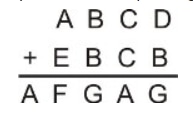
Find the value of B + A + D if each alphabet represent an unique single digit from 0 - 9.
Answer: A. 14 — In a cryptarithmetic addition puzzle, every distinct letter stands for a unique digit from 0-9, and the puzzle must satisfy ordinary base-10 column addition:…
- A.
14
- B.
15
- C.
16
- D.
17
Show answer & explanation
Correct answer: A
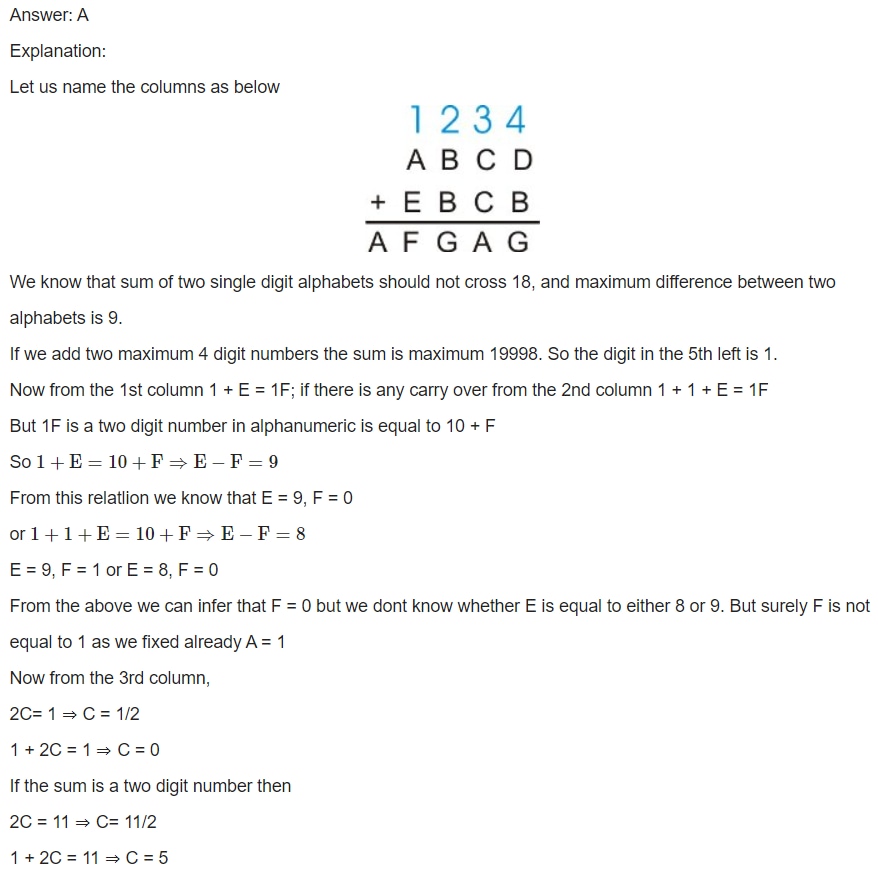
In a cryptarithmetic addition puzzle, every distinct letter stands for a unique digit from 0-9, and the puzzle must satisfy ordinary base-10 column addition: carries propagate from the units column leftward into each next column, and no leading digit of a multi-digit number is 0. Because the sum of two 4-digit numbers can never reach 20000, the leading digit of a 5-digit result is forced to be exactly 1.
Align the two 4-digit addends, ABCD and EBCB, under the 5-digit sum AFGAG, and write the column equations from right to left using c1, c2, c3, c4 for the carries out of the units, tens, hundreds, and thousands columns: D + B = G + 10c1 (units); C + C + c1 = A + 10c2 (tens); B + B + c2 = G + 10c3 (hundreds); A + E + c3 = F + 10c4 (thousands); and c4 = A (the sum's leading digit).
Since ABCD and EBCB are each at most 9999, their sum is at most 19998 - so the leading digit of the 5-digit result can only be 1. This fixes c4 = 1, and therefore A = 1.
Substituting A = 1 into the thousands column gives 1 + E + c3 = F + 10. Checking both possible values of c3 shows the only branch that does not force F to repeat the digit already used for A leaves F = 0.
Substituting A = 1 into the tens column gives 2C + c1 = 1 + 10c2. Checking both possible carries rules out every case where C comes out as a non-integer or repeats a digit already fixed, leaving the single valid case C = 5, with c1 = 1 and c2 = 1.
With c1 = 1 and c2 = 1 now fixed, the units column (D + B = G + 10) and the hundreds column (2B + 1 = G + 10c3) must hold together. Combining the two shows D and B must be consecutive digits (D = B + 1) large enough that their column also carries into the thousands place.
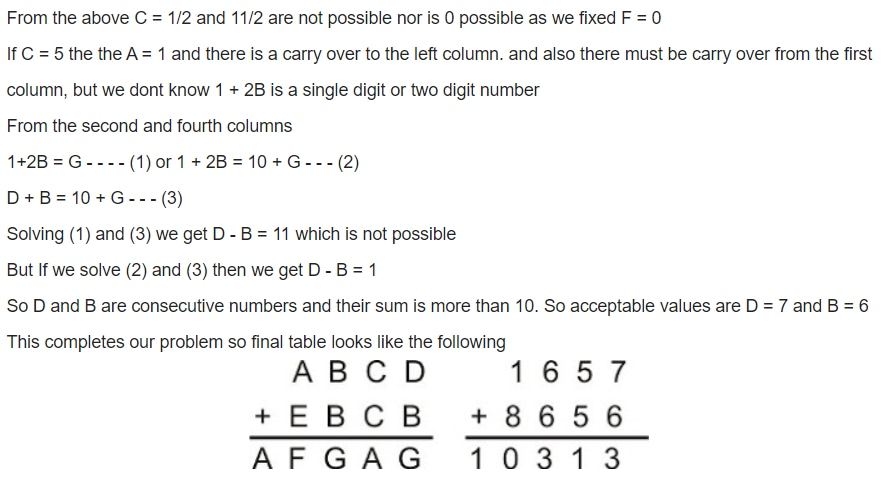
Testing the remaining unused digits against this consecutive-pair condition, the only assignment that keeps all seven letters distinct is B = 6 and D = 7 - which fixes G = 3, c3 = 1, and, completing the thousands column from step 3, E = 8.
Substituting every letter back in confirms the addition: ABCD = 1657 and EBCB = 8656, and 1657 + 8656 = 10313, which reads exactly as AFGAG = 1 0 3 1 3 - every column checks out and every letter keeps a distinct digit.
With A = 1, B = 6, and D = 7, the requested sum is B + A + D = 6 + 1 + 7 = 14.