The sum of the digits of a three digit number is 17 and sum of the squares of…
2024
The sum of the digits of a three digit number is 17 and sum of the squares of its digits is 109. If we subtract 495 from the number, we shall get a number consisting of the same digits written in reverse order. Find the number.
Answer: A. 863 — A three-digit number can be written in place-value form as 100a + 10b + c, where a, b, c are its hundreds, tens, and units digits (a is 1-9; b, c are 0-9).…
- A.
863
- B.
935
- C.
683
- D.
754
Attempted by 17 students.
Show answer & explanation
Correct answer: A
A three-digit number can be written in place-value form as 100a + 10b + c, where a, b, c are its hundreds, tens, and units digits (a is 1-9; b, c are 0-9). Reversing the digits swaps the hundreds and units places, giving 100c + 10b + a — this identity is what turns a "digit sum / sum of squares / reversal" clue into simultaneous equations in a, b, c.
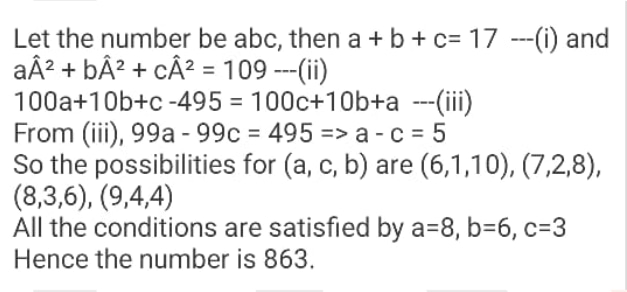
Let the number be 100a + 10b + c. The digit-sum clue gives a + b + c = 17.
The sum-of-squares clue gives a2 + b2 + c2 = 109.
Subtracting 495 gives the digit-reversed number: 100a + 10b + c − 495 = 100c + 10b + a.
Simplifying: 99a − 99c = 495, so a − c = 5.
From a − c = 5 and a + b + c = 17, substituting a = c + 5 gives b = 12 − 2c.
Substituting a = c + 5 and b = 12 − 2c into a2 + b2 + c2 = 109 gives (c+5)2 + (12−2c)2 + c2 = 109, which simplifies to 6c2 − 38c + 60 = 0, i.e. 3c2 − 19c + 30 = 0.
Solving the quadratic: c = (19 ± 1) / 6, so c = 3 or c = 10/3 (rejected — not a digit). So c = 3, a = 8, b = 6.
The number is 100(8) + 10(6) + 3 = 863.
Cross-check on 863: digit sum 8 + 6 + 3 = 17 ✓; sum of squares 82 + 62 + 32 = 64 + 36 + 9 = 109 ✓; 863 − 495 = 368, which is exactly 863 with its digits reversed ✓. All three conditions hold, confirming the number is 863.