8 litres are drawn from a cask full of wine and replaced with water. This…
20262024
8 litres are drawn from a cask full of wine and replaced with water. This operation is repeated three more times (so the replacement is carried out 4 times in total). The ratio of the quantity of wine now left in the cask to that of water is 16 : 65. How much wine did the cask hold originally?
Answer: B. 24 litres — Concept: In a repeated-replacement mixture problem, when a fixed quantity d is withdrawn from a container of total volume V (originally pure liquid A) and…
- A.
18 litres
- B.
24 litres
- C.
32 litres
- D.
42 litres
Attempted by 45 students.
Show answer & explanation
Correct answer: B
Concept: In a repeated-replacement mixture problem, when a fixed quantity d is withdrawn from a container of total volume V (originally pure liquid A) and replaced by liquid B each time, the fraction of the original liquid A remaining after n such operations is (1 - d/V)n. This is the standard replacement formula used whenever a mixture undergoes several successive draw-and-replace steps.
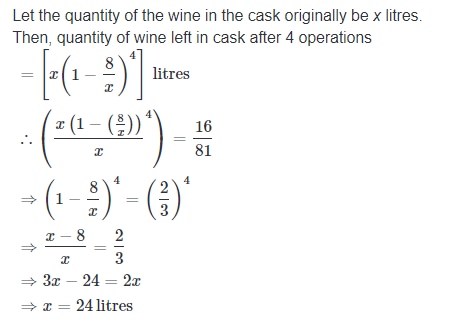
Application: Let the cask originally hold x litres of wine. Each time, d = 8 litres is drawn out and replaced with water, and this is done 4 times in total (the initial draw plus three more repeats). So the wine remaining is x(1 - 8/x)4 litres.
The ratio of wine left to water is given as 16 : 65, so the fraction of wine remaining out of the total volume is 16/(16 + 65) = 16/81.
Equating the two expressions for the wine fraction: (1 - 8/x)4 = 16/81.
Write 16/81 as a fourth power: 16 = 24 and 81 = 34, so 16/81 = (2/3)4.
Since both sides are raised to the 4th power, equate the bases: 1 - 8/x = 2/3.
Solve for x: 8/x = 1/3, so x = 3 × 8 = 24.
Cross-check: Substitute x = 24 back into the expression: 1 - 8/24 = 2/3, and (2/3)4 = 16/81, exactly matching the given ratio 16 : 65. So the cask originally held 24 litres of wine.