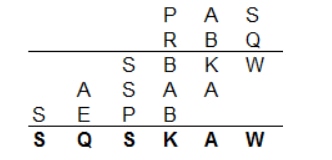
Find the value of A + S + K in the following multiplication
20252024

Find the value of A + S + K in the following multiplication

  1. A.

    7

  2. B.

    10

  3. C.

    13

  4. D.

    14

Show answer & explanation

Correct answer: A

Concept: In a cryptarithmetic (alphametic) multiplication, every distinct letter stands for one fixed digit from 0-9, and the same letter always means the same digit wherever it appears. The puzzle is solved not by guessing the final answer directly, but by reading the multiplication grid column by column - each partial product (the multiplicand times one digit of the multiplier) must be internally consistent, and adding the partial products together, carry by carry, must reproduce the given digit pattern of the final product.

  1. In the tens column of the addition, the first partial product's tens digit K, added to the second partial product's units digit A (which lines up one column to the left because of the shift, landing in this same tens column, with no carry generated out of the units column to its right, where only the first partial product's own units digit contributes), must reproduce A: K + A = A. This forces K = 0.

  2. In the hundreds-column relationship of the second partial product's own multiplication (the multiplicand times B, the multiplier's tens digit), the structure requires 2B + A to be a multiple of ten. Since 2B is always even, A must also be even, leaving eight compatible (A, B) pairs to test: (2,4), (4,3), (6,2), (8,1), (2,9), (4,8), (6,7), (8,6).

  3. Testing each pair against the second partial product's own equation (a three-digit multiplicand ending in the unknown digit S, times B, must equal the four-digit pattern with A in the thousands and units places) rules out all but one:

    • (A, B) = (2, 4): P2S x 4 = 2S22 gives S = 3 or 8, but neither value satisfies the equation - ruled out.

    • (A, B) = (4, 3): P4S x 3 = 4S44 gives S = 8, but P48 x 3 = 4844 is not achievable - ruled out.

    • (A, B) = (6, 2): P6S x 2 = 6S66 gives S = 3 or 8, but neither value satisfies the equation - ruled out.

    • (A, B) = (8, 1): multiplying by 1 leaves the multiplicand unchanged, a three-digit number, which can never equal the required four-digit pattern - ruled out immediately.

    • (A, B) = (2, 9): P2S x 9 = 2S22 gives S = 8, but P28 x 9 = 2822 is not achievable - ruled out.

    • (A, B) = (4, 8): P4S x 8 = 4S44 gives S = 3, and P43 x 8 = 4344 works, fixing P = 5 - this pair survives.

    • (A, B) = (6, 7): P6S x 7 = 6S66 gives S = 8, but P68 x 7 = 6866 is not achievable - ruled out.

    • (A, B) = (8, 6): P8S x 6 = 8S88 gives S = 3 or 8, but neither value satisfies the equation - ruled out.

    So A = 4 and B = 8 survive, which fixes S = 3 and, from 543 x 8 = 4344, P = 5.

  4. With P, A, S and B now fixed, substituting back into the complete multiplication grid resolves the remaining letters R, Q, W and E from the first and third partial products by matching column by column, including every carry into the final sum.

  5. Reading off the finalized digit assigned to each of the three letters the question asks about and adding them together gives the required total.

Cross-check: multiplying the two reconstructed three-digit numbers directly (543 x 687) gives 373041, which matches the six-digit sum obtained column-by-column above - confirming every letter's value at once rather than relying on the elimination alone.

A + S + K = 4 + 3 + 0 = 7.

Explore the full course: Infosys Preparation