Let S be the set of all points (x,y) in the x-y plane such that |x| + |y| ≤ 2…
2025
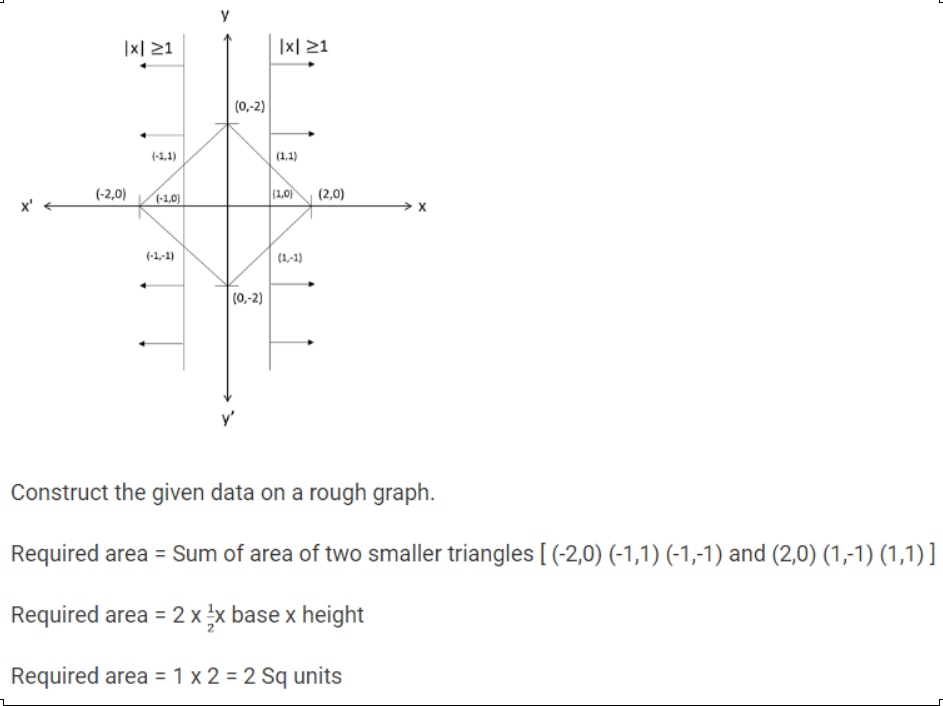
Let S be the set of all points (x,y) in the x-y plane such that |x| + |y| ≤ 2 and |x| ≥ 1. Then, the area, in square units, of the region represented by S equals
Answer: C. 2 Sq units — Concept: The region |x| + |y| ≤ k is a square (a "diamond") centered at the origin with vertices at (±k, 0) and (0, ±k); its area is 2k2. Imposing the extra…
- A.
9 Sq units
- B.
3 Sq units
- C.
2 Sq units
- D.
7 Sq units
Attempted by 1 students.
Show answer & explanation
Correct answer: C
Concept: The region |x| + |y| ≤ k is a square (a "diamond") centered at the origin with vertices at (±k, 0) and (0, ±k); its area is 2k2. Imposing the extra condition |x| ≥ a removes the vertical strip −a < x < a from this diamond, leaving two symmetric triangular slivers near its left and right vertices.
Application: Here k = 2 and a = 1. By symmetry, find the area of the right-hand piece (x ≥ 1) and double it.
For x in [1, 2], the diamond condition |x| + |y| ≤ 2 becomes |y| ≤ 2 − x, since |x| = x when x ≥ 1.
At x = 1, |y| ≤ 1, so y runs from −1 to 1; at x = 2, |y| ≤ 0, giving only the point (2, 0). So this piece is the triangle with vertices (1, 1), (1, −1) and (2, 0).
This triangle has a vertical base of length 2 (from (1, −1) to (1, 1)) and a horizontal height of 1 (from x = 1 to x = 2), so its area is (1/2) × 2 × 1 = 1 square unit.
By the symmetry x → −x, the mirror piece for x in [−2, −1] — the triangle with vertices (−1, 1), (−1, −1), (−2, 0) — has the same area, 1 square unit.
Adding the two pieces gives the total area of S.
Cross-check: The full diamond |x| + |y| ≤ 2 has area 2 × 22 = 8 (using the standard formula for |x| + |y| ≤ k). The excluded middle strip −1 < x < 1 splits into two trapezoids by symmetry about x = 0: from x = −1 to x = 0, the vertical width 2(2 − |x|) grows linearly from 2 to 4, giving area (2+4)/2 × 1 = 3; the mirror piece from x = 0 to x = 1 gives another 3. So the excluded strip has area 3 + 3 = 6, and 8 − 6 = 2 — matching the two-triangle sum above.