If the total number of dots on opposite faces of a cubical block is always 7,…
2025
If the total number of dots on opposite faces of a cubical block is always 7, find the figure which is correct.
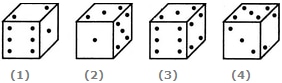
Answer: B. 2 — Concept: On a standard cubical die, the two dot-counts on any pair of opposite faces always add up to 7 - so 1 is opposite 6, 2 is opposite 5, and 3 is…
- A.
1
- B.
2
- C.
3
- D.
4
Attempted by 1 students.
Show answer & explanation
Correct answer: B
Concept: On a standard cubical die, the two dot-counts on any pair of opposite faces always add up to 7 - so 1 is opposite 6, 2 is opposite 5, and 3 is opposite 4. A consequence follows immediately: any three faces that meet at one corner of the cube (exactly the top, front and right faces you see in an isometric sketch) are always mutually adjacent, so none of these three visible faces can ever be a 7-summing pair - a die's opposite faces are never shown together in a single such sketch.
Application: tally the dots on the top, front and right face of each figure and check every pair for a sum of 7.
Figure | Top | Front | Right | Adjacent pair summing to 7? | Verdict |
|---|---|---|---|---|---|
1 | 2 | 6 | 1 | front + right = 6 + 1 = 7 | Impossible |
2 | 3 | 1 | 5 | 3+1=4, 3+5=8, 1+5=6 - none is 7 | Consistent |
3 | 3 | 6 | 4 | top + right = 3 + 4 = 7 | Impossible |
4 | 5 | 3 | 2 | top + right = 5 + 2 = 7 | Impossible |
Cross-check: using the complementary pairs directly - a face showing 3 must have 4 hidden behind it, a face showing 1 must have 6 hidden behind it, and a face showing 5 must have 2 hidden behind it. In the arrangement with 3 on top, 1 in front and 5 on the right, the three hidden faces are therefore 4, 6 and 2 - none of which clashes with the three visible dot-counts (3, 1, 5). This confirms there is no contradiction.
Hence the figure showing 3 dots on top, 1 dot in front and 5 dots on the right is the only arrangement consistent with the opposite-faces-sum-to-7 rule.