Ricky, after travelling 5 km, took a right turn and travelled 6 km. He then…
2023
Ricky, after travelling 5 km, took a right turn and travelled 6 km. He then took a left turn and travelled 3 km. Find his final distance from home.
Answer: A. 10 km — When a path is made of straight segments joined only by right-angle turns, the straight-line distance from the starting point (the displacement) is found by…
- A.
10 km
- B.
19 km
- C.
9 km
- D.
90 km
Attempted by 2 students.
Show answer & explanation
Correct answer: A
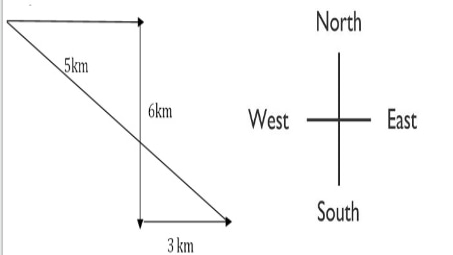
When a path is made of straight segments joined only by right-angle turns, the straight-line distance from the starting point (the displacement) is found by resolving the whole path into two perpendicular components - one along the original direction of travel, one perpendicular to it - and applying the Pythagorean theorem. A right turn followed by a left turn always restores the original direction of travel, so any leg walked after that pair adds to the very first leg's component, not the middle one's.
Take Ricky's first direction of travel as the reference direction; he covers 5 km along it.
The right turn puts him on a direction perpendicular to the reference direction; he covers 6 km along this new direction.
The left turn from that heading brings him back to face the original reference direction, so the final 3 km leg lies along the SAME direction as the first leg, not the second.
Component along the reference direction: 5 km + 3 km = 8 km. Component perpendicular to it: 6 km.
Straight-line distance from home = √(82 + 62) = √(64 + 36) = √(100) = 10 km.
This is just the standard 3-4-5 right triangle scaled by 2 (6-8-10), so the arithmetic checks out; and since a right turn followed by a left turn always cancels back to the original heading, the same "first leg + third leg" vs "second leg" split holds no matter which compass direction Ricky actually started in.