A thief hides his loot in a house. As the police chase him, he runs 2 kms to…
2023
A thief hides his loot in a house. As the police chase him, he runs 2 kms to the west before taking a right turn and running for another 2 kms. He then takes a right turn and runs for another 7 kms. Finally, he takes two right turns and runs 2 kms after taking each turn and defeats the police. How far must he walk in order to reach the house in which he had hidden the loot?
Answer: B. 3 kms — Concept: In a direction-sense problem, track each leg of the journey as a displacement in one of the four compass directions, using the turn rule — a right…
- A.
2 kms
- B.
3 kms
- C.
4 kms
- D.
5 kms
Attempted by 3 students.
Show answer & explanation
Correct answer: B
Concept: In a direction-sense problem, track each leg of the journey as a displacement in one of the four compass directions, using the turn rule — a right turn rotates the direction of travel 90° clockwise, a left turn rotates it 90° counter-clockwise. The distance to return to the starting point is the straight-line (net) displacement between the final position and the start, found by summing the East-West and North-South legs separately, not by adding up every leg travelled.
Start at the house facing West and walk 2 km West.
Turn right (West to North) and walk 2 km North.
Turn right (North to East) and walk 7 km East.
Turn right (East to South) and walk 2 km South.
Turn right (South to West) and walk 2 km West.
Net North-South displacement: the 2 km North leg and the 2 km South leg cancel exactly, so the finishing point is at the same north-south level as the house.
Net East-West displacement: 7 km East against a total of 2 km + 2 km = 4 km West gives a net separation of 7 − 4 = 3 km to the east of the house.
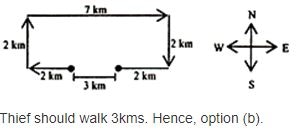
Cross-check: plotting the five legs on a compass grid and reading off the final coordinates relative to the house confirms the same 3 km east-west gap, with zero north-south gap, so the straight-line distance back to the house is 3 km.
He must walk 3 km to reach the house where the loot is hidden.