Six dice with upper faces erased are as shown. The sum of the numbers of dots…
2023202520252023
Six dice with upper faces erased are as shown.
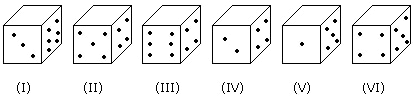
The sum of the numbers of dots on the opposite face is 7.
If dice (I), (II) and (III) have even number of dots on their bottom faces and the dice (IV), (V) and (VI) have odd number of dots on their top faces, then what would be the difference in the total number of top faces between these two sets?
Answer: D. 6 — Concept: On a standard die, dots on any pair of opposite faces always add up to 7 (1–6, 2–5, 3–4). When a die is drawn showing only two adjacent faces, the…
- A.
0
- B.
2
- C.
4
- D.
6
Attempted by 4 students.
Show answer & explanation
Correct answer: D
Concept: On a standard die, dots on any pair of opposite faces always add up to 7 (1–6, 2–5, 3–4). When a die is drawn showing only two adjacent faces, the hidden face directly opposite each visible face is fixed by this rule; whatever dot-count is left over — neither shown nor used as an opposite — is shared between the top and bottom faces. A single extra clue about the parity (odd/even) of the top or bottom face is then enough to tell the two remaining faces apart.
Application: For dice (I), (II) and (III) the parity clue describes the bottom face; for dice (IV), (V) and (VI) the parity clue describes the top face directly. Reading the two visible faces of each die from the figure and applying the rule above gives:
Die | Visible faces | Excluded opposites | Left-over pair | Given clue | Top face |
|---|---|---|---|---|---|
(I) | 3, 6 | 4, 1 | 2, 5 | bottom even | 5 |
(II) | 5, 4 | 2, 3 | 1, 6 | bottom even | 1 |
(III) | 6, 4 | 1, 3 | 2, 5 | bottom even | 5 |
(IV) | 2, 4 | 5, 3 | 1, 6 | top odd | 1 |
(V) | 1, 5 | 6, 2 | 3, 4 | top odd | 3 |
(VI) | 4, 5 | 3, 2 | 1, 6 | top odd | 1 |
Total of top faces for dice (I), (II), (III) = 5 + 1 + 5 = 11.
Total of top faces for dice (IV), (V), (VI) = 1 + 3 + 1 = 5.
Required difference = 11 − 5 = 6.
As a check, every one of the three opposite-face pairs (1–6, 2–5, 3–4) is used exactly once across each die's three faces (the two shown plus the derived top) — confirming each die's dot pattern is a consistent standard die, not an arbitrary assignment.