Select the figure that will replace the question mark (?) in the following…
2023
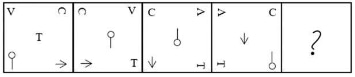
Select the figure that will replace the question mark (?) in the following series.
Attempted by 4 students.
Show answer & explanation
Concept
A pictorial series is generated by repeating a fixed operation from one panel to the next, and two operations account for most such series: a re-seating, in which every mark travels to a fixed destination seat while keeping the orientation it already had, and a turning, in which every mark stays in its seat and is rotated through an angle fixed by that seat. When no single operation reproduces every step, the next thing to test is whether two operations alternate. Reading the rule is therefore a two-part question asked seat by seat: did the mark in this seat change seat, or did it change orientation?
Application
Every panel of this series uses the same five seats — top-left, top-right, centre, bottom-left and bottom-right — and the same five marks: an angle, an arc, a T-mark, an arrow and a pin (a small circle on a straight stalk). The table records what sits in each seat, with its orientation, for the four given panels.
Panel | Top-left | Top-right | Centre | Bottom-left | Bottom-right |
|---|---|---|---|---|---|
1 | angle opening up | arc opening down | T-mark, stem down | pin, circle above stalk | arrow pointing right |
2 | arc opening down | angle opening up | pin, circle above stalk | arrow pointing right | T-mark, stem down |
3 | arc opening right | angle opening left | pin, circle below stalk | arrow pointing down | T-mark, stem left |
4 | angle opening left | arc opening right | arrow pointing down | T-mark, stem left | pin, circle below stalk |
Panel 1 to Panel 2: not one mark changes its orientation, so this step is a pure re-seating. The two top marks trade seats with each other, while the remaining three run round a three-seat cycle bottom-left to centre, centre to bottom-right, bottom-right to bottom-left. Call this re-seating rule R.
Panel 2 to Panel 3: not one mark changes its seat, so this step is a pure turning. The arc in the top-left goes from opening down to opening right and the angle in the top-right goes from opening up to opening left, a quarter turn anticlockwise in each of the two top seats. The arrow in the bottom-left goes from pointing right to pointing down and the T-mark in the bottom-right goes from stem down to stem left, a quarter turn clockwise in each of the two bottom seats. The pin in the centre goes from circle above stalk to circle below stalk, a half turn. Call this turning rule S: top seats a quarter anticlockwise, bottom seats a quarter clockwise, centre a half turn.
Panel 3 to Panel 4: orientations are again untouched and the seats move exactly as in the first step, so rule R applies once more.
The two rules therefore alternate R, S, R, S, and so the step from Panel 4 into the question mark must be rule S: every mark stays where it is and turns by the amount its seat prescribes.
Apply S to Panel 4. Top-left: the angle turns a quarter anticlockwise from opening left to opening down. Top-right: the arc turns a quarter anticlockwise from opening right to opening up. Centre: the arrow takes a half turn from pointing down to pointing up. Bottom-left: the T-mark turns a quarter clockwise from stem left to stem up, which lays its bar along the bottom. Bottom-right: the pin turns a quarter clockwise from circle below stalk to circle left of stalk.
The panel that completes the series therefore carries an angle opening downward at the top-left, an arc opening upward at the top-right, an arrow pointing up at the centre, a T-mark whose bar lies along the bottom with its stem standing up at the bottom-left, and a pin whose circle sits to the left of its stalk at the bottom-right.
Cross-check
Two of the five marks — the angle and the arc — are the pair that swaps between the two top seats at every re-seating step, so at a turning step each of them is always sitting in a top seat and therefore always takes a quarter turn anticlockwise. The T-mark, the arrow and the pin instead run round the centre-and-bottom cycle, and of those three only the T-mark is in a bottom seat at both turning steps, so it always takes a quarter turn clockwise. That fixes three orientations from nothing more than which half of the panel a mark occupies, without re-running the seat-by-seat application: the angle reads opening up in Panel 1, opening left in Panel 3 and therefore opening down in Panel 5; the arc reads opening down, then opening right, and therefore opening up; the T-mark reads stem down, then stem left, and therefore stem up. All three agree with the panel derived above, and those three seats alone already separate the four arrangements offered:
The arrangement carrying an arc opening downward, an arrow pointing down and a T-mark with its bar along the top departs from the derived panel in three seats at once.
The arrangement carrying an angle opening upward, an arrow pointing down and a T-mark with its stem lying to the left departs from the derived panel in three seats.
The arrangement carrying an angle opening rightward, an arc opening leftward and a pin with its circle above its stalk departs from the derived panel in three seats.
The arrangement that carries that exact combination of five orientations is the one that completes the series.