If the water source is placed along M-N, as shown in the figure, which of the…
2026
If the water source is placed along M-N, as shown in the figure, which of the given options will be the water reflection of the given figure?
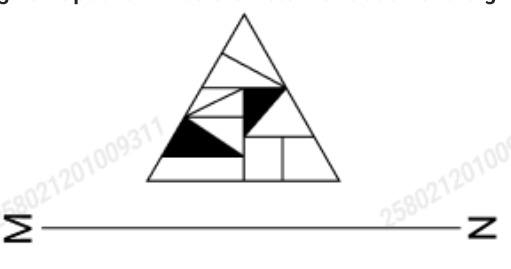
Attempted by 93 students.
Show answer & explanation
Concept: A water reflection is the mirror image of a figure in a horizontal axis — the surface of the water. Every point of the object is copied to the same horizontal position, at an equal distance on the other side of the water line. So the vertical order of the whole drawing reverses, while the horizontal order is left untouched. A water image is a top-to-bottom flip only: nothing is turned about a centre and nothing is swapped between left and right.
Application to this drawing:
The water line M-N is horizontal and lies below the triangle, so the whole triangle is flipped top to bottom about that line.
The object stands on its base with the apex at the top. After the flip the base lies along the top, closest to the water line, and the apex points straight down.
Distance from the water line is preserved, so the part of the object nearest the water reflects nearest the water: the lower strip of the object becomes the topmost strip of the image, and the apex becomes the lowest point of the image.
The wide black band lies low in the left half of the object. Its horizontal position does not change and its height is mirrored, so in the image it lies high in the left half.
The small black triangle lies just above the mid-height, a little to the right of centre. In the image it lies just below the mid-height, still a little to the right of centre.
The pair of small white boxes at the right end of the object’s lower strip appears at the right end of the image’s topmost strip.
Cross-check and contrast:
Reading the object away from the water line gives this sequence: lower strip, then the level carrying the wide black band and the small black triangle, then the plain upper level, then the apex. Reading the image downwards from the water line must give the same sequence, and it does for the inverted triangle whose base lies along the top, with the wide black band high in the left half and the small black triangle just below it, right of centre.
A drawing that still stands on its base, apex upwards, cannot be a water image at all, because the top-to-bottom order has not been reversed.
A drawing that is upside down but also has its left and right ends exchanged — wide black band high in the right half, small black triangle left of centre — is a half turn about the centre, that is, a water image followed by a further lateral mirror.
A drawing whose internal shading itself differs from the object, for example a solid black upright rectangle standing at the middle of the lower strip, cannot be any reflection of it: a reflection moves shapes, it never changes them.
Result: the water reflection is the inverted triangle whose base lies along the top nearest M-N, with the wide black band high in the left half, the pair of small white boxes at the right end of the topmost strip, the small black triangle just right of centre below the band, and the apex pointing down.