How many triangles are there in the given figure?
2019
How many triangles are there in the given figure?
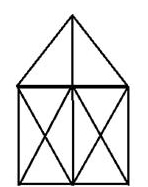
Answer: A. 23 — Concept — In any line drawing, a triangle exists wherever three of the drawn straight lines meet pairwise at three distinct points and all three joining…
- A.
23
- B.
17
- C.
25
- D.
18
Attempted by 9 students.
Show answer & explanation
Correct answer: A
Concept — In any line drawing, a triangle exists wherever three of the drawn straight lines meet pairwise at three distinct points and all three joining segments are actually drawn. Counting triangles is therefore bookkeeping, not spotting: a reliable count first fixes every corner and every interior crossing point, then divides the drawing into fixed parts, counts inside each part by size, and only at the end adds the triangles that borrow lines from two parts at once.
Application — label the drawing first:
The square has corners A (bottom-left), B (bottom-right), C (top-right) and D (top-left); M is the midpoint of the base AB and E is the midpoint of the top side DC.
The roof has apex P directly above E, slanting sides DP and CP, and a vertical PE running from the apex down to the top side of the square.
Inside the square, EM is the central vertical; DM and AE cross at X in the left half, while EB and MC cross at Y in the right half.
Now sweep part by part:
Left half of the square (A, D, E, M, crossing at X): the four smallest triangles ADX, AMX, EMX and DEX, plus the four half-size ones ADE, ADM, AEM and DEM — 8 triangles.
Right half of the square (M, E, C, B, crossing at Y): the mirror set BMY, BCY, CEY and EMY, plus BCE, BCM, BEM and CEM — 8 triangles.
Spanning the full width of the square: ABE, standing on the whole base with its apex at E, and DCM, standing on the whole top side with its apex at M — 2 triangles.
The roof taken alone: DEP and CEP on either side of the vertical, plus the complete roof DCP — 3 triangles.
Borrowing lines from both parts: PE and EM lie on one straight line, so PM is a single side; with DM and DP it forms DMP, and with MC and CP it forms CMP — 2 triangles.
Adding up: 8 + 8 + 2 + 3 + 2 = 23 triangles.
Part of the drawing | Triangles |
|---|---|
Left half of the square | 8 |
Right half of the square | 8 |
Spanning the full width of the square | 2 |
Roof taken alone | 3 |
Using PM with a slanting side | 2 |
Total | 23 |
Cross-check — recount by size instead of by part. Inside the square there are 8 smallest triangles (four in each crossed half), 8 half-square triangles (four in each half) and 2 that span its full width, giving 18; the roof contributes 2 half-roof triangles and the whole roof, giving 3; and carrying the roof's vertical down to M creates 2 more. 18 + 3 + 2 = 23, the same total as the part-by-part sweep.
Guard against the two standard slips: X and Y are genuine crossings of drawn lines, so they are legitimate vertices and the small cells around them must be opened; and PE together with EM is one straight side PM, which is what makes the two triangles that reach from the apex down to the base midpoint possible.