Count the number of triangles and squares in the given figure.
2025
Count the number of triangles and squares in the given figure.
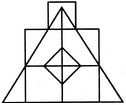
Answer: A. 21 triangles, 7 squares — ConceptWhen a figure combines several overlapping triangles or squares, count them by grouping shapes according to how many elementary (undivided) regions…
- A.
21 triangles, 7 squares
- B.
18 triangles, 8 squares
- C.
20 triangles, 8 squares
- D.
22 triangles, 7 squares
Attempted by 10 students.
Show answer & explanation
Correct answer: A
Concept
When a figure combines several overlapping triangles or squares, count them by grouping shapes according to how many elementary (undivided) regions each one spans. Start with the simplest shapes made of a single elementary region, then work upward through 2-part, 3-part, and larger composite shapes formed by combining adjacent regions, listing every distinct shape once in each group. Adding the group totals across all levels for each shape type gives the final triangle count and square count separately.
Application
The figure is labelled as shown below.
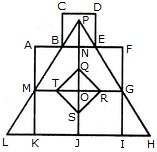
Label the figure's vertices and intersection points as shown.
Simplest triangles (1 elementary region each): BPN, PNE, ABM, EFG, MLK, GHI, QRO, RSO, STO and QTO — 10 triangles.
Triangles made of 2 regions each: BPE, TQR, QRS, RST and STQ — 5 triangles.
Triangles made of 3 regions each: MPO and GPO — 2 triangles.
Triangles made of 6 regions each: LPJ, HPJ and MPG — 3 triangles.
The single largest triangle, made of 12 regions: LPH — 1 triangle.
Total triangles = 10 + 5 + 2 + 3 + 1 = 21.
Squares made of 2 regions each: KJOM and JIGQ — 2 squares.
Squares made of 3 regions each: ANOM, NFGO and CDEB — 3 squares.
The single square made of 4 regions: QRST — 1 square.
The single largest square, made of 10 regions: AFIK — 1 square.
Total squares = 2 + 3 + 1 + 1 = 7.
Cross-check
Recounting each group independently, and checking that every listed triangle or square encloses a distinct set of elementary regions with none repeated or omitted, reproduces the same 21 and 7 totals — confirming the count is exhaustive and non-duplicative.