Consider the Deterministic Finite-state Automaton (DFA) A shown below. The DFA…
2023
Consider the Deterministic Finite-state Automaton (DFA) A shown below. The DFA runs on the alphabet {0, 1}, and has the set of states {s, p, q, r}, with s being the start state and p being the only final state.
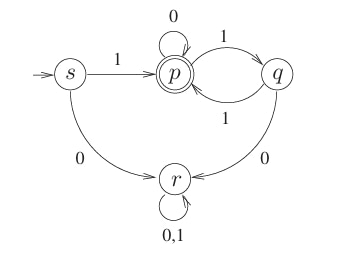
Which one of the following regular expressions correctly describes the language accepted by A?
- A.
1(0∗11)∗
- B.
0(0 + 1)∗
- C.
1(0 + 11)∗
- D.
1(110∗)∗
Attempted by 167 students.
Show answer & explanation
Correct answer: C
Correct regular expression: 1(0 + 11)*
Reasoning:
The first symbol must be 1: from the start state, reading 0 goes to a non-accepting sink state, so any string beginning with 0 is rejected.
From the accepting state, reading 0 loops back to the accepting state, so each 0 after the initial 1 can appear anywhere and keep the string accepted.
From the accepting state, reading a single 1 moves you to a non-accepting state; a second 1 is required to return to the accepting state. Thus 11 acts as an indivisible block that returns to acceptance.
Combining these facts gives: the string must start with 1, and the rest is any number (possibly zero) of either a 0 or the pair 11. That is exactly 1(0+11)*.
Examples accepted:
"1" (initial 1, no further symbols)
"10" (1 then a 0 loop in accepting state)
"111" (1 then the pair 11)
"10011" (1, zeros, then the pair 11)
Examples rejected:
"" (the empty string is rejected because the DFA requires a leading 1)
"0" (starts with 0 and goes to the non-accepting sink)
"11" (after the initial 1 a single 1 moves to a non-accepting state and the string ends there)