Consider the pushdown automaton (PDA) P below, which runs on the input…
GATE · 2023 · CS · Computer Science & IT
Consider the pushdown automaton (PDA) P below, which runs on the input alphabet {a, b}, has stack alphabet {⊥, A}, and has three states {s, p, q}, with s being the start state. A transition from state u to state v, labelled c/X/γ, where c is an input symbol or ε, X is a stack symbol, and γ is a string of stack symbols, represents the fact that in state u, the PDA can read c from the input, with X on the top of its stack, pop X from the stack, push in the string γ on the stack, and go to state v. In the initial configuration, the stack has only the symbol ⊥ in it. The PDA accepts by empty stack.
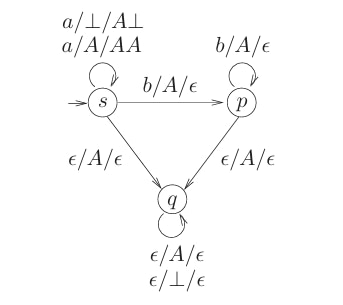
Which one of the following options correctly describes the language accepted by P?
- A.
{am bn | 1 ≤ m and n < m}
- B.
{am bn | 0 ≤ n ≤ m}
- C.
{am bn | 0 ≤ m and 0 ≤ n}
- D.
{am | 0 ≤ m} ∪ {bn | 0 ≤ n}
Attempted by 118 students.
Sign up free to check your answer
Sign up freeLoading lesson…