Consider the NFA M shown below. Let the language accepted by M be L. Let L1 be…
2003
Consider the NFA M shown below.
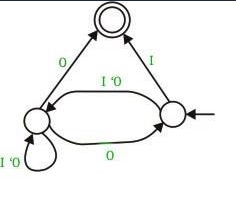
Let the language accepted by M be L. Let L1 be the language accepted by the NFA M1, obtained by changing the accepting state of M to a non-accepting state and by changing the non-accepting state of M to accepting states. Which of the following statements is true ?
Answer: B. L1 = {0, 1}* — Key insight: after swapping accepting and non-accepting states in this NFA, every string over {0,1} has a nondeterministic run that ends in an accepting…
- A.
L1 = {0, 1}* - L
- B.
L1 = {0, 1}*
- C.
L1 ⊆ L
- D.
L1 = L
Attempted by 170 students.
Show answer & explanation
Correct answer: B
Key insight: after swapping accepting and non-accepting states in this NFA, every string over {0,1} has a nondeterministic run that ends in an accepting state.
Why every string is accepted (case analysis):
Empty string: the start state was non-accepting in the original machine, so it becomes accepting in the modified machine. Hence the empty string is accepted.
Strings beginning with 0: from the start state there is a transition on 0 to the left state. The left state is accepting in the modified machine and has self-loops on both 0 and 1, so it can consume the remainder of the input and accept.
Strings beginning with 1: from the start state there is a transition on 1 into the top state, and from that top state there are transitions on the next input symbol that reach one of the now-accepting states (start or left). Once such an accepting state is reached it can loop to consume the rest of the input. Therefore any longer string starting with 1 can be guided into an accepting state.
Single-symbol string "1": although one run reading the single 1 may end in the former accepting (now non-accepting) top state, nondeterminism allows choosing a run that reaches an accepting state (for example, by moving so that the remainder of the computation ends in the start or left state). Thus the single-symbol string is also accepted.
Conclusion: for every w in {0,1}* there exists at least one accepting run in the modified NFA, so the language accepted after swapping final and non-final states is the entire set {0,1}*.