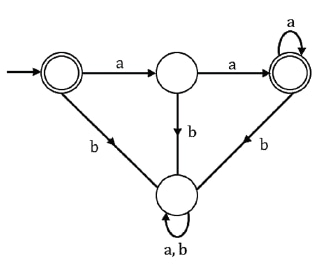
Consider a language L over ∑={a,b} given below. The number of states in min…
Consider a language L over ∑={a,b} given below. The number of states in min DFA of L are ____:
L= {ax | x= 2y+3z | y,z ≥ 0 }
Answer: D. 4 — Explanation: The language L is defined as L = {ax | x = 2y + 3z, y, z ≥ 0}. The set of possible values for x is the set of all non-negative integers that can…
- A.
7
- B.
6
- C.
5
- D.
4
Attempted by 47 students.
Show answer & explanation
Correct answer: D
Explanation:
The language L is defined as L = {ax | x = 2y + 3z, y, z ≥ 0}.
The set of possible values for x is the set of all non-negative integers that can be expressed as 2y + 3z. This set includes 0 (y=0, z=0), 2 (y=1, z=0), 3 (y=0, z=1), 4 (y=2, z=0), 5 (y=1, z=1), 6 (y=3, z=0 or y=0, z=2), and so on. The only non-negative integer not in this set is 1.
Therefore, L consists of strings of the form a followed by a suffix of length 0, 2, 3, 4, 5, etc., but not length 1. The strings in L are: ε (length 0), aa (length 2), aaa (length 3), aaaa (length 4), aaaaa (length 5), aaaaaa (length 6), and so on.
To construct the minimal DFA for L, we need to distinguish between strings of different lengths. The key observation is that the language accepts strings of length 0, 2, 3, 4, 5, 6, etc., but not length 1. The minimal DFA must have states to track the length of the input string modulo the period of the language.
The set of lengths {0, 2, 3, 4, 5, 6, ...} has a period of 1, but the key is the absence of length 1. The minimal DFA must have states to track the length modulo the greatest common divisor of 2 and 3, which is 1. However, the number of states required is determined by the number of distinct equivalence classes of lengths under the language's structure.
The minimal DFA for L will have states corresponding to the number of 'a's read so far, modulo the period of the language. Since the language accepts all lengths except 1, the minimal DFA will have states to track the length modulo the period of the language.
The number of states in the minimal DFA is determined by the number of distinct residue classes of lengths under the language's structure. The minimal DFA will have states to track the length modulo the period of the language, which is 1. However, the key is the absence of length 1.
The minimal DFA for L will have states to track the length of the input string modulo the period of the language. The number of states required is determined by the number of distinct equivalence classes of lengths under the language's structure.
The minimal DFA for L will have states to track the length of the input string modulo the period of the language. The number of states required is determined by the number of distinct equivalence classes of lengths under the language's structure.