Given a language 𝐿, define 𝐿𝑖 as follows: 𝐿0 = {πœ€} 𝐿𝑖 = πΏπ‘–βˆ’1 β‹… 𝐿…

2018

Given a language 𝐿, define 𝐿𝑖 as follows:

𝐿0 = {πœ€}

𝐿𝑖 = πΏπ‘–βˆ’1 β‹… 𝐿 π‘“π‘œπ‘Ÿ π‘Žπ‘™π‘™ 𝑖 > 0

The order of a language 𝐿 is defined as the smallestΒ \(k\) such that πΏπ‘˜ = πΏπ‘˜+1 .

Consider the language 𝐿1 (over alphabet 0) accepted by the following automaton.
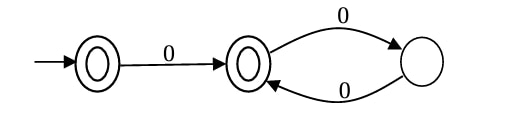
The order of 𝐿1 is _____.

Attempted by 109 students.

Show answer & explanation

Correct answer: 2

Answer: 2

Explanation:

  • From the automaton: the start state is accepting, and after one 0 you reach another accepting state. Further 0s alternate between an accepting and a non-accepting state. So the language L consists of the empty string and all nonempty strings of odd length: L = {Ξ΅} βˆͺ {0(00)*}.

  • Compute powers:

    β€’ L^0 = {Ξ΅}.

    β€’ L^1 = L = {Ξ΅} βˆͺ odd-length strings of 0s.

    β€’ L^2 = L β‹… L. Looking at lengths: {0} βˆͺ odd plus itself gives every nonnegative integer (0 = 0+0, any odd = odd+0, any even β‰₯2 = odd+odd). So L^2 = 0* (all strings of 0s).

    β€’ Once we have L^2 = 0*, further concatenation with L leaves 0* unchanged, so L^3 = L^2.

  • Therefore the smallest k with L^k = L^{k+1} is k = 2.

Explore the full course: Gate Guidance By Sanchit Sir