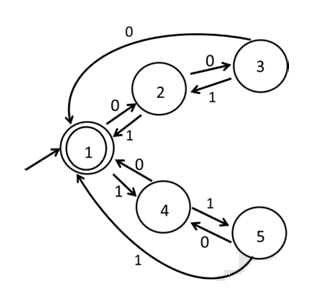
Consider the 5-state DFA 𝑀 accepting the language 𝐿(𝑀) βŠ‚ (0 + 1)βˆ— shown…

2024

Consider the 5-state DFA 𝑀 accepting the language 𝐿(𝑀) βŠ‚ (0 + 1)βˆ— shown below. For any string 𝑀 ∈ (0 + 1)βˆ— let \(n_0\)(𝑀) be the number of 0 β€² 𝑠 in 𝑀 and \(n_1\)(𝑀) be the number of 1′𝑠 in 𝑀.

Which of the following statements is/are FALSE?

  1. A.

    States 2 and 4 are distinguishable in 𝑀

  2. B.

    States 3 and 4 are distinguishable in 𝑀

  3. C.

    States 2 and 5 are distinguishable in 𝑀

  4. D.

    Any string 𝑀 with \(n_0\)(𝑀) = \(n_1\)(𝑀) is in 𝐿(𝑀)

Attempted by 139 students.

Show answer & explanation

Correct answer: B, C

Key idea: use the symmetry of the automaton to decide which state-pairs are equivalent or distinguishable.

Observation:

  • The automaton has a clear top/bottom symmetry: the top branch contains states 2 and 3, the bottom branch contains states 4 and 5, and the start state (state 1) is the single accepting state.

  • Define the state-mapping f that swaps the top and bottom branches and fixes the start: f(1)=1, f(2)=5, f(5)=2, f(3)=4, f(4)=3.

  • By inspecting the transition structure (the labels on edges in the diagram), f commutes with transitions: for every state s and input symbol a, f(delta(s,a)) = delta(f(s),a). In other words, f is an automorphism of the transition graph that preserves input behavior.

Consequences of the automorphism:

  • Because f maps the accepting state 1 to itself, acceptance is preserved under f: for any state s and any suffix x, reading x from s leads to acceptance iff reading x from f(s) leads to acceptance.

  • Therefore states paired by f are indistinguishable: specifically, states 2 and 5 are equivalent, and states 3 and 4 are equivalent.

Answering the question (which statements are FALSE):

  • The statements that claim states 3 and 4 are distinguishable and that states 2 and 5 are distinguishable are both false, because those pairs are indistinguishable by the automorphism argument above.

  • The statement that states 2 and 4 are distinguishable is true (they lie in different equivalence classes), and the statement that any string with equal numbers of 0s and 1s is accepted is also true because the machine’s symmetric transitions return to the start (the accepting state) exactly when the counts balance.

Final result: The false statements are the ones that assert distinguishability of the symmetric pairs (states 3 and 4) and (states 2 and 5).

A video solution is available for this question β€” log in and enroll to watch it.

Explore the full course: Gate Guidance By Sanchit Sir