The process state transition diagram of an operating system is as given below.…

2006

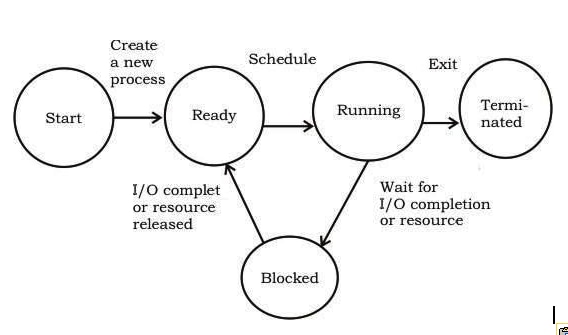
The process state transition diagram of an operating system is as given below.

Which of the following must be FALSE about the above operating system?
download (3)

  1. A.

    It is a multiprogrammed operating system

  2. B.

    It uses preemptive scheduling

  3. C.

    It uses non-preemptive scheduling

  4. D.

    It is a multi-user operating system

Attempted by 696 students.

Show answer & explanation

Correct answer: B

Answer: The statement "It uses preemptive scheduling" is FALSE.

Key observation: The diagram does not show any transition from the Running state back to the Ready state caused by the scheduler (for example, a time-slice expiry or preemption).

  • What the diagram shows: The only outgoing transitions from Running are to Blocked (waiting for I/O or resource) and to Terminated (Exit). There is a Ready -> Running transition labeled "Schedule."

  • Why preemptive scheduling is ruled out: Preemptive scheduling requires an explicit Running -> Ready transition triggered by the scheduler (e.g., time-slice expiration). Since no such transition is shown, preemption is not indicated.

  • Why non-preemptive scheduling is supported: Processes leave the CPU only by blocking for I/O or by exiting, which is the behavior of non-preemptive (cooperative) scheduling.

  • Multiprogramming: The existence of Ready and Blocked states implies the OS can manage multiple processes concurrently (keeps processes in memory while others run), so the diagram is consistent with a multiprogrammed OS.

  • Multi-user: The diagram does not contain information about the number of users. State-transition structure is compatible with both single-user and multi-user systems, so this cannot be inferred from the diagram alone.

Conclusion: Because the diagram lacks a scheduler-driven Running -> Ready transition, the claim that the system uses preemptive scheduling must be FALSE; the other statements are either supported by the diagram (multiprogrammed, non-preemptive) or are not contradicted by it (multi-user).

A video solution is available for this question — log in and enroll to watch it.

Explore the full course: Gate Guidance By Sanchit Sir