A square paper, shown in figure (I), is folded along the dotted lines as shown…
2025
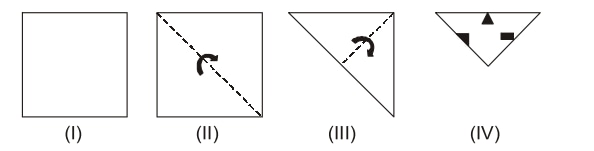
A square paper, shown in figure (I), is folded along the dotted lines as shown in the figures (II) and (III). Then a few cuts are made as shown in figure (IV). Which one of the following patterns will be obtained when the paper is unfolded?
Note: The figures shown are representative.
Attempted by 104 students.
Show answer & explanation
Key insight: each fold mirrors the paper, so each cut on the small folded wedge is reproduced by reflections when the paper is unfolded.
First fold (diagonal): the square becomes a right isosceles triangle. Anything cut on the folded piece will be mirrored across the diagonal when unfolded.
Second fold (triangle folded again): the triangle is reduced to a smaller triangular wedge. Cuts made at this stage lie in that wedge and will be reflected across both fold lines when the paper is fully opened.
Unfolding sequence: first undo the second fold to get the right triangle with mirrored cuts, then undo the diagonal fold to get the full square. Each cut on the wedge therefore produces multiple symmetric copies on the full square.
The small square-shaped cut near the pointed tip of the wedge becomes a square mark at each of the four corners of the full square.
The triangular cut near the hypotenuse of the wedge becomes a triangular mark at the midpoint of each side of the full square (because it is reflected across the fold lines to the four side midpoints).
Conclusion: The unfolded pattern must show square marks at the four corners and triangular marks at the midpoint of each side. The image that displays small squares at each corner and small triangles at the midpoints of the sides is the correct unfolded result.
A video solution is available for this question — log in and enroll to watch it.