In a triangle PQR, PS is the angle bisector of ∠ QPR and ∠ QPS = 60°. What is…
2015
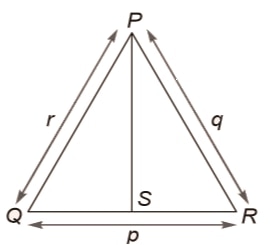
In a triangle PQR, PS is the angle bisector of ∠ QPR and ∠ QPS = 60°. What is the length of PS?
- A.
\(\frac {(q + r)} {qr}\) - B.
\(\frac {qr} {q + r}\) - C.
\(\sqrt {(q^2 + r^2)}\) - D.
\(\frac {(q + r)^2} {qr}\)
Attempted by 66 students.
Show answer & explanation
Correct answer: B
Key idea: PS bisects ∠QPR and ∠QPS = 60°, so the full angle at P is 120°.
Formula: The length of the internal angle bisector between sides of lengths r and q with included angle θ is l = (2 r q cos(θ/2)) / (r + q).
Identify values: the two sides adjacent to the angle are r and q, and the included angle θ = 120°, so θ/2 = 60°.
Evaluate cosine: cos(60°) = 1/2.
Substitute into the bisector formula: l = (2 · r · q · cos(60°)) / (r + q) = (2 r q · 1/2)/(r + q) = r q/(r + q).
Therefore PS = r q/(r + q).
Final answer: PS = r q/(r + q).