The figure below shows an annular ring with outer and inner as b and a,…

2020

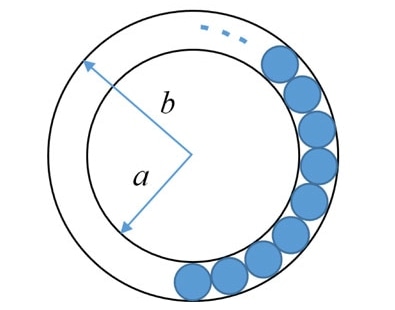
The figure below shows an annular ring with outer and inner as b and a, respectively. The annular space has been painted in the form of blue colour circles touching the outer and inner periphery of annular space. If maximum n number of circles can be painted, then the unpainted area available in annular space is _________ .
  1. A.

    π × [ (b² − a²) − (n/4)(b − a)² ]

  2. B.

    π × [ (b² − a²) − (n)(b − a)3 ]

  3. C.

    π × [ (b² − a²) − (n)(a − b)² ]

  4. D.

    π × [ (b² − a²) − (n)(b − a)1/2 ]

Attempted by 64 students.

Show answer & explanation

Correct answer: A

Key idea: a circle tangent to both the inner and outer concentric circles has radius equal to half the radial gap.

  • Radius of each painted circle: r = (b - a)/2.

  • Area of one painted circle: π r^2 = π((b - a)^2)/4.

  • Area of the annulus (entire painted region before placing small circles): π(b^2 - a^2).

  • Total painted area by n circles: n × π((b - a)^2)/4.

Therefore the unpainted area = π(b^2 - a^2) - n × π((b - a)^2)/4 = π[(b^2 - a^2) - (n/4)(b - a)^2].

Note:

  1. The centers of the small circles lie on the mid-circle of radius R = (a + b)/2. For adjacent painted circles to be tangent, their center-to-center chord length must equal b - a, which leads to sin(π/n) = (b - a)/(a + b).

  2. Thus the theoretical value n = π / arcsin((b - a)/(a + b)). The maximum integer number of circles that can be painted is the floor of this value.

This derivation yields the unpainted area expression π[(b^2 - a^2) - (n/4)(b - a)^2], matching the correct answer.

A video solution is available for this question — log in and enroll to watch it.

Explore the full course: Gate Guidance By Sanchit Sir