A plot of land must be divided between four families. They want their…

20222024

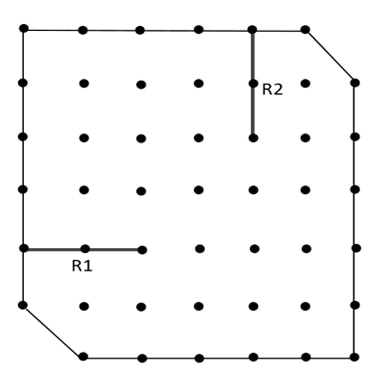
A plot of land must be divided between four families. They want their individual plots to be similar in shape, not necessarily equal in area. The land has equally spaced poles, marked as dots in the below figure. Two ropes, R1 and R2, are already present and cannot be moved.

What is the least number of additional straight ropes needed to create the desired plots? A single rope can pass through three poles that are aligned in a straight line.
  1. A.

    2

  2. B.

    4

  3. C.

    5

  4. D.

    3

Attempted by 258 students.

Show answer & explanation

Correct answer: D

Answer: 3 additional straight ropes.

Explanation:

  • Key idea: Create four plots that are similar in shape by completing boundary lines that use the grid of aligned poles. The two fixed ropes provide two partial boundaries; we add the minimum number of straight ropes (each through aligned poles) to finish three more boundaries so the four regions are similar.

  • Placement of the three new ropes (one feasible arrangement):

    • Add one straight vertical rope through a column of aligned poles so it pairs with the existing vertical rope and creates a vertical division.

    • Add one straight horizontal rope through a row of aligned poles so it pairs with the existing horizontal rope and creates a horizontal division.

    • Add a third straight rope (aligned with available poles) to complete the remaining boundaries so that each of the four regions has the same arrangement of boundary segments and hence similar shapes.

  • Why three is minimal:

    1. With only one additional rope you cannot reach four regions; at most two regions would be formed by a single straight boundary.

    2. With only two additional ropes it is not possible, given the fixed positions of the two existing ropes, to arrange all four regions so they are similar. Two added ropes either produce fewer than four regions or create unequal/asymmetric regions because you lack the required combination of parallel and joining boundaries through the pole grid.

    3. Three added ropes are the first number that allows completing the necessary set of straight boundary segments (using aligned poles) to form four regions with the same boundary pattern, so three is minimal.

  • Conclusion: Place three additional straight ropes as described to obtain four similar plots. Any larger number of added ropes would be unnecessary for achieving the goal; any smaller number cannot produce four similar plots given the constraints.

A video solution is available for this question — log in and enroll to watch it.

Explore the full course: Gate Guidance By Sanchit Sir