Three different views of a dice are shown in the figure below. The piece of…
2024
Three different views of a dice are shown in the figure below.
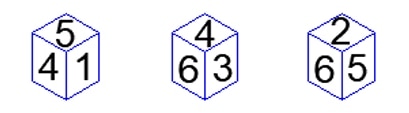
The piece of paper that can be folded to make this dice is
Attempted by 69 students.
Show answer & explanation
Key fact: opposite faces on this dice can be determined from the three given views.
From the left view we see the three visible faces are 5 (top), 4 and 1 (sides). Therefore 5 is adjacent to 4 and to 1.
From the middle view we see 4 (top) with 6 and 3 as its two visible side faces. Therefore 4 is adjacent to 6 and to 3.
From the right view we see 2 (top) with 6 and 5 as its visible side faces. Therefore 2 is adjacent to 6 and to 5.
Using these adjacency relations, each face must be adjacent to four others and opposite one face. The only consistent opposite pairs are:
4 is opposite 2
5 is opposite 3
6 is opposite 1
Check the candidate nets against these requirements.
The correct net is the one that places 5 and 1 next to each other across the top, with 4 directly below the 1, then 6 below 4, and with 2 and 3 attached to the lower-right. This layout keeps each required opposite pair separated and produces the adjacencies seen in the three views (5 adjacent to 4 and 1; 4 adjacent to 6 and 3; 2 adjacent to 6 and 5), so it folds to the shown dice.
Any net that puts 5 next to 3, or 4 next to 2, or 6 next to 1 is invalid because those pairs must be opposite on the folded cube. Such nets therefore cannot produce the three given views.
Conclusion: the net described above is the only candidate among the choices that satisfies the adjacency information from all three views and keeps the deduced opposite pairs separated, so it is the correct net.