Consider Guwahati (G) and Delhi (D) whose temperatures can be classified as…
GATE · 2018 · CS · Computer Science & IT
Consider Guwahati (G) and Delhi (D) whose temperatures can be classified as high (𝐻), medium (𝑀) and low (𝐿). Let 𝑃(𝐻𝐺 ) denote the probability that Guwahati has high temperature. Similarly, 𝑃(𝑀𝐺 ) and 𝑃(𝐿𝐺 ) denotes the probability of Guwahati having medium and low temperatures respectively. Similarly, we use 𝑃(𝐻𝐷), 𝑃(𝑀𝐷) and 𝑃(𝐿𝐷) for Delhi.
The following table gives the conditional probabilities for Delhi’s temperature given Guwahati’s temperature.
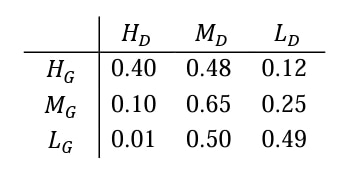
Consider the first row in the table above. The first entry denotes that if Guwahati has high temperature (𝐻𝐺) then the probability of Delhi also having a high temperature (𝐻𝐷) is 0.40; i.e., 𝑃(𝐻𝐷|𝐻𝐺 ) = 0.40. Similarly, the next two entries are 𝑃(𝑀𝐷|𝐻𝐺 ) = 0.48 and 𝑃(𝐿𝐷|𝐻𝐺 ) = 0.12. Similarly for the other rows.
If it is known that 𝑃(𝐻𝐺 ) = 0.2, 𝑃(𝑀𝐺 ) = 0.5, and 𝑃(𝐿𝐺 ) = 0.3, then the probability (correct to two decimal places) that Guwahati has high temperature given that Delhi has high temperature is _______.
Attempted by 53 students.
Sign up free to check your answer
Sign up freeLoading lesson…