Given the following Bayesian Network consisting of four Bernoulli random…
2024
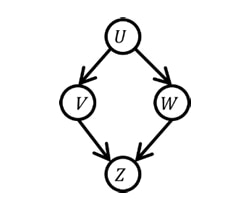
Given the following Bayesian Network consisting of four Bernoulli random variables and the associated conditional probability tables:
P(U):
U | P(U) |
|---|---|
0 | 0.5 |
1 | 0.5 |
P(V | U):
U | P(V=0 | U) | P(V=1 | U) |
|---|---|---|
0 | 0.5 | 0.5 |
1 | 0.5 | 0.5 |
P(W | U):
U | P(W=0 | U) | P(W=1 | U) |
|---|---|---|
0 | 1 | 0 |
1 | 0 | 1 |
P(Z | V, W):
V | W | P(Z=0 | V, W) | P(Z=1 | V, W) |
|---|---|---|---|
0 | 0 | 0.5 | 0.5 |
0 | 1 | 1 | 0 |
1 | 0 | 1 | 0 |
1 | 1 | 0.5 | 0.5 |
The value of P(U=1, V=1, W=1, Z=1) = ______ (rounded off to three decimal places).
Show answer & explanation
Correct answer: 0.125
Concept: In a Bayesian network, the joint probability of all the random variables factorises according to the graph structure — it equals the product, over every node in the network, of that node's own conditional probability given only its parent nodes: P(node | parents(node)). This chain-rule factorisation is exactly why a Bayesian network stores one small conditional probability table (CPT) per node instead of one giant joint table over all the variables together.
Application: In this network, U has no parents (a root node), V's only parent is U, W's only parent is U, and Z's parents are V and W together. So the required joint probability breaks down as P(U=1, V=1, W=1, Z=1) = P(U=1) × P(V=1 | U=1) × P(W=1 | U=1) × P(Z=1 | V=1, W=1). Reading each factor off its own table:
From the P(U) table: P(U=1) = 0.5.
From the P(V | U) table: P(V=1 | U=1) = 0.5.
From the P(W | U) table: P(W=1 | U=1) = 1 — this row is deterministic, since U=1 forces W=1 with certainty.
From the P(Z | V, W) table: P(Z=1 | V=1, W=1) = 0.5.
Multiply the four factors together: 0.5 × 0.5 × 1 × 0.5 = 0.125.
Cross-check: Because P(W=1 | U=1) = 1 and P(W=0 | U=0) = 1, W is completely determined by U in this network — it copies U's value with certainty, so fixing W=1 adds no extra uncertainty once U=1 is already fixed. Dropping that deterministic factor and recomputing the same joint probability without it gives the identical value: P(U=1) × P(V=1 | U=1) × P(Z=1 | V=1, W=1) = 0.5 × 0.5 × 0.5 = 0.125, confirming the result.
So P(U=1, V=1, W=1, Z=1) = 0.125.