Let f(x) = (5x + 1)2 for all x > 0. Then f-1(x) is:
Let f(x) = (5x + 1)2 for all x > 0. Then f-1(x) is:
Show answer & explanation
Concept: To find the inverse of a function, write y = f(x), solve explicitly for x in terms of y — choosing the branch consistent with any domain restriction — then swap variable names so the inverse is expressed as a function of x. A function has an inverse on a domain where it is one-to-one; a quadratic restricted to x > 0 is one-to-one there because it is strictly increasing on that domain.
Application:
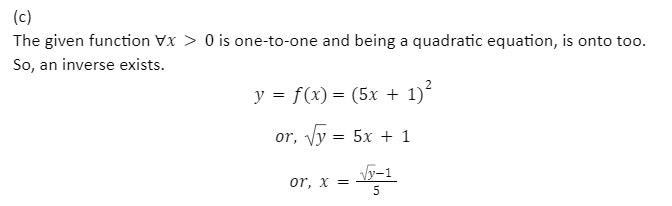
Write y = f(x) = (5x + 1)².
Since x > 0, we have 5x + 1 > 1 > 0, so taking the square root of both sides gives the positive root: √y = 5x + 1 (the negative root is rejected because 5x + 1 is positive on this domain).
Isolate x: 5x = √y − 1, so x = (√y − 1)/5.
Replace y by x to write the inverse function: f⁻¹(x) = (√x − 1)/5 = 1/5(√x − 1).
Cross-check: Compose f with the result: f(f⁻¹(x)) = [5·(√x − 1)/5 + 1]² = (√x − 1 + 1)² = (√x)² = x, confirming the inverse is consistent.
Result: So f⁻¹(x) = 1/5(√x − 1), matching this option's value.
Domain note: Since 5x + 1 ranges over (1, ∞) as x ranges over (0, ∞), and squaring is increasing on positive values, f maps (0, ∞) onto (1, ∞); so f⁻¹(x) = 1/5(√x − 1) is meaningful for x > 1, matching the range of f.
Source working (as originally supplied):