The coefficient of x2 in the series is __________
The coefficient of x2 in the series
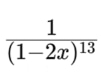
is __________
Answer: 364 — Concept: For a real index k and constant a with |ax| < 1, the generalized binomial expansion gives (1 − ax)-k = Σ (n = 0 to ∞) C(n+k−1, n)·an·xn. So the…
Show answer & explanation
Correct answer: 364
Concept: For a real index k and constant a with |ax| < 1, the generalized binomial expansion gives (1 − ax)-k = Σ (n = 0 to ∞) C(n+k−1, n)·an·xn. So the coefficient of xn in this expansion is C(n+k−1, n)·an — the ordinary binomial coefficient scaled by an, not the binomial coefficient alone.
Application: Matching (1 − 2x)-13 to the standard form and finding the coefficient of x2:
Match the given series to the standard form (1 − ax)⁻k: here a = 2 and k = 13.
The required term is the coefficient of x², so n = 2.
Substitute into the general coefficient formula: C(n+k−1, n)·aⁿ = C(2+13−1, 2)·2² = C(14, 2)·4.
Evaluate the binomial coefficient: C(14, 2) = (14 × 13) / (2 × 1) = 91.
Multiply by a² = 2² = 4: coefficient = 91 × 4 = 364.
Cross-check: Expanding directly, (1 − 2x)-13 = 1 + 13(2x) + [13·14/2!](2x)2 + … = 1 + 26x + 91×4·x2 + … = 1 + 26x + 364x2 + … The x2 term again gives 364, confirming the result independently.
Result: the coefficient of x2 is 364.
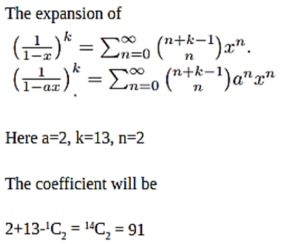
Note on the reference image below: it correctly computes C(14, 2) = 91, which is only the binomial-coefficient part of the general term — it still needs to be multiplied by a2 = 22 = 4 to give the full coefficient, 364.