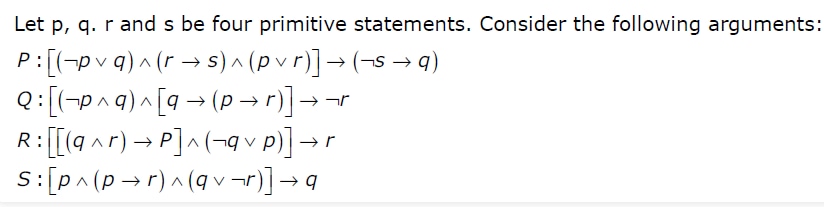
Which of the above arguments are valid?
2004

Which of the above arguments are valid?
- A.
P and Q only
- B.
P and R only
- C.
P and S only
- D.
P, Q, R and S
Attempted by 63 students.
Show answer & explanation
Correct answer: C
Answer: P and S are valid; Q and R are not. Brief justifications follow.
P is valid. Reason: From (¬p ∨ q), (r → s), and (p ∨ r), assume ¬s. Then r cannot be true (since r → s would give s), so r is false and p must be true (from p ∨ r). With p true, ¬p is false, so ¬p ∨ q forces q. Hence ¬s → q holds.
S is valid. Reason: From p and p → r deduce r. Given q ∨ ¬r and r true, ¬r is false, so q must be true. Thus the conclusion q follows.
Q is invalid. Counterexample: Take p = false, q = true, r = true. Then ¬p ∧ q is true and q → (p → r) holds, but ¬r is false. So premises can be true while the conclusion is false.
R is invalid. Counterexample: Take q = false, r = false, and p arbitrary (for example p = false). Then (q ∧ r) → p is true and ¬q ∨ p is true, while r is false. So the premises do not force the conclusion.