P and Q are two propositions. Which of the following logical expressions are…
2008
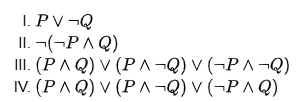
P and Q are two propositions. Which of the following logical expressions are equivalent?
- A.
Only I, II and III
- B.
Only I, II and IV
- C.
All of I, II, III and IV
- D.
Only I and II
Attempted by 180 students.
Show answer & explanation
Correct answer: A
Key idea: use De Morgan's and distributive laws to simplify each expression.
Expression I: P ∨ ¬Q (leave as is).
Expression II: ¬(¬P ∧ Q) = ¬¬P ∨ ¬Q by De Morgan's law = P ∨ ¬Q.
Expression III: (P ∧ Q) ∨ (P ∧ ¬Q) ∨ (¬P ∧ ¬Q).
Simplify the first two terms: (P ∧ Q) ∨ (P ∧ ¬Q) = P ∧ (Q ∨ ¬Q) = P.
So III = P ∨ (¬P ∧ ¬Q). Using distributivity, P ∨ (¬P ∧ ¬Q) = (P ∨ ¬P) ∧ (P ∨ ¬Q) = P ∨ ¬Q.
Expression IV: (P ∧ Q) ∨ (P ∧ ¬Q) ∨ (¬P ∧ Q).
Again simplify the first two terms to P. Then IV = P ∨ (¬P ∧ Q) = (P ∨ ¬P) ∧ (P ∨ Q) = P ∨ Q.
This differs from P ∨ ¬Q in general (for example, when P = false and Q = false, P ∨ ¬Q is true while P ∨ Q is false).
Conclusion: The first, second and third expressions are equivalent (all equal to P ∨ ¬Q). The fourth expression is equivalent to P ∨ Q and is not equivalent to the others.
A video solution is available for this question — log in and enroll to watch it.