A graph G = (V, E) satisfies |E| ≤ 3 |V| - 6. The min-degree of G is defined…

2003

A graph G = (V, E) satisfies |E| ≤ 3 |V| - 6. The min-degree of G is defined as
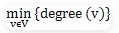
image.png

. Therefore, min-degree of G cannot be

  1. A.

    3

  2. B.

    4

  3. C.

    5

  4. D.

    6

Attempted by 137 students.

Show answer & explanation

Correct answer: D

Key idea: if the minimum degree is at least 6 then the total degree sum forces |E| ≥ 3|V|, contradicting the given bound.

  • Let δ be the minimum degree of G. The sum of degrees equals 2|E|.

  • If δ ≥ 6 then the sum of degrees is at least 6|V|, so 2|E| ≥ 6|V| and therefore |E| ≥ 3|V|.

  • This contradicts the given inequality |E| ≤ 3|V| - 6, because |E| cannot be simultaneously ≥ 3|V| and ≤ 3|V| - 6.

Conclusion: The minimum degree cannot be 6. Values 3, 4, and 5 are not ruled out by the bound; brief notes follow.

  • Minimum degree 3: Possible. It implies |E| ≥ 1.5|V|, which is compatible with |E| ≤ 3|V| - 6.

  • Minimum degree 4: Possible for sufficiently large |V|. If every vertex has degree at least 4 then |E| ≥ 2|V|; for example, a 4-regular graph on 6 vertices meets the bound (|E| = 12 = 3·6 - 6).

  • Minimum degree 5: Possible for sufficiently large |V|. If every vertex has degree at least 5 then |E| ≥ 2.5|V|, and 2.5|V| ≤ 3|V| - 6 holds when |V| ≥ 12 (a 5-regular graph on 12 vertices is an example).

A video solution is available for this question — log in and enroll to watch it.

Explore the full course: Gate Guidance By Sanchit Sir