Consider the partial implementation of a 2-bit counter using T flip-flops…

2004

Consider the partial implementation of a 2-bit counter using T flip-flops following the sequence 0-2-3-1-0, as shown below 
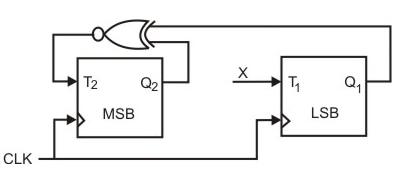
image.png

To complete the circuit, the input X should be

  1. A.

    Q2'

  2. B.

    Q2 + Q1

  3. C.

    (Q1 ⊕ Q2)'

  4. D.

    Q1 ⊕ Q2

Attempted by 79 students.

Show answer & explanation

Correct answer: D

Key insight: For a T flip-flop, the output toggles when T = 1 and remains the same when T = 0. Thus T = current_Q ⊕ next_Q.

Apply this to the least significant bit (LSB). List the current state (Q2 Q1), the next state, and the needed T for Q1:

  1. State 00 → next 10: Q1 is 0 → 0, so T1 = 0

  2. State 10 → next 11: Q1 is 0 → 1, so T1 = 1

  3. State 11 → next 01: Q1 is 1 → 1, so T1 = 0

  4. State 01 → next 00: Q1 is 1 → 0, so T1 = 1

So the required T1 values for states 00, 10, 11, 01 are 0, 1, 0, 1 respectively.

Compare this to the Boolean expression Q1 ⊕ Q2 evaluated for the same states:

  • 00: Q1 ⊕ Q2 = 0

  • 10: Q1 ⊕ Q2 = 1

  • 11: Q1 ⊕ Q2 = 0

  • 01: Q1 ⊕ Q2 = 1

Conclusion: The required input X for the LSB T flip-flop is Q1 ⊕ Q2.

A video solution is available for this question — log in and enroll to watch it.

Explore the full course: Gate Guidance By Sanchit Sir