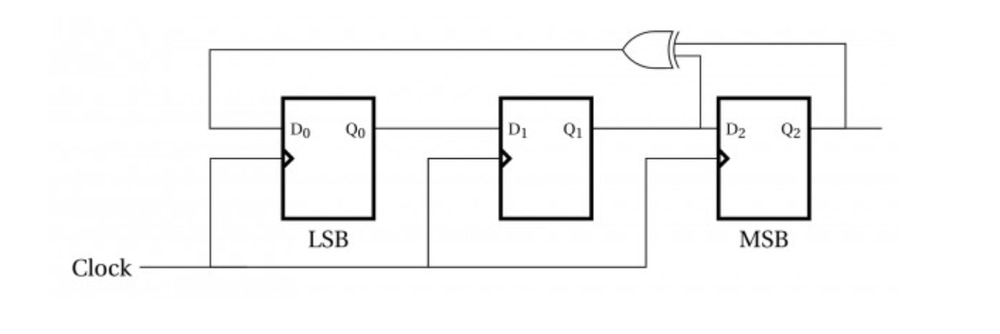
Consider the circuit given below with initial state Q0 =1, Q1 = Q2 = 0. The…
2001
Consider the circuit given below with initial state Q0 =1, Q1 = Q2 = 0. The state of the circuit is given by the value 4Q2 + 2Q1 + Q0
Which one of the following is the correct state sequence of the circuit?
- A.
1,3,4,6,7,5,2
- B.
1,2,5,3,7,6,4
- C.
1,2,7,3,5,6,4
- D.
1,6,5,7,2,3,4
Attempted by 29 students.
Show answer & explanation
Correct answer: B
1. Understanding the Circuit Equations
The circuit consists of three positive edge-triggered D flip-flops. The state of the circuit is represented as a 3-bit binary number (Q2 Q1 Q0)2, where its decimal value is given by:
State Value = 4Q2 + 2Q1 + Q0
By looking at the connections in the diagram, we can derive the next-state equations for each flip-flop:
D0: The input to the first flip-flop comes from the output of the XOR gate. The inputs to this XOR gate are Q1 and Q2.
D0 = Q1 ⊕ Q2
D1: The input comes directly from the output of the previous flip-flop.
D1 = Q0
D2: The input comes directly from the output of the second flip-flop.
D2 = Q1
Since for a D flip-flop, the next state Qnext = D, our state transition equations are:
Q0(next) = Q1 ⊕ Q2
Q1(next) = Q0
Q2(next) = Q1
2. Step-by-Step State Transition (Solution)
We are given the initial state as Q0 = 1, Q1 = 0, Q2 = 0.
This means the starting binary state is 0012, which equals 1 in decimal.
Let's track the states for each clock cycle:
Present State | Next State Inputs | Next State | ||||||
Q2 | Q1 | Q0 | D2 | D1 | D0 | Q2(next) | Q1(next) | Q0(next) |
0 | 0 | 0 | 0 | 0 | 0 ⊕ 0 = 0 | 0 | 0 | 0 |
0 | 0 | 1 | 0 | 1 | 0 ⊕ 0 = 0 | 0 | 1 | 0 |
0 | 1 | 0 | 1 | 0 | 1 ⊕ 0 = 1 | 1 | 0 | 1 |
0 | 1 | 1 | 1 | 1 | 1 ⊕ 0 = 1 | 1 | 1 | 1 |
1 | 0 | 0 | 0 | 0 | 0 ⊕ 1 = 1 | 0 | 0 | 1 |
1 | 0 | 1 | 0 | 1 | 0 ⊕ 1 = 1 | 0 | 1 | 1 |
1 | 1 | 0 | 1 | 0 | 1 ⊕ 1 = 0 | 1 | 0 | 0 |
1 | 1 | 1 | 1 | 1 | 1 ⊕ 1 = 0 | 1 | 1 | 0 |
The equation 4Q2 + 2Q1 + Q0 is used to convert the multi-bit binary state of a sequential circuit (like a counter or a register) into a single, easily readable decimal number.
The generated decimal sequence is: 1, 2, 5, 3, 7, 6, 4 (and then it loops back to 1).