Which of the following input sequences will always generate a 1 at the output…

2005

Which of the following input sequences will always generate a 1 at the output z at the end of the third cycle?
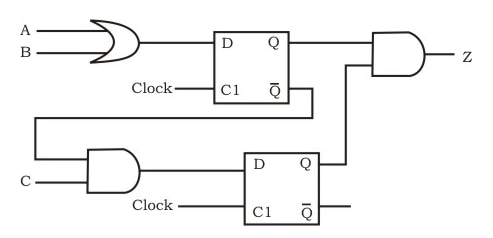
image.png

  1. A.

    0 0 0 1 0 1 1 1 1

  2. B.

    1 0 1 1 1 0 1 1 1

  3. C.

    0 1 1 1 0 1 1 1 1

  4. D.

    0 0 1 1 1 0 1 1 1

Attempted by 13 students.

Show answer & explanation

Correct answer: D

Assumption: the long feedback wire feeding the lower AND gate is the Q output of the top flip-flop (not Q̄), and the final output z is the AND of the two Q outputs.

Key insight: evaluate the flip-flops cycle by cycle. Each clock edge samples the D inputs simultaneously.

  • Top flip-flop D input = A OR B, so Q_top at the end of cycle n equals A_n OR B_n.

  • Lower flip-flop D input = C AND Q_top(previous). Therefore Q_bottom at the end of cycle n equals C_n AND Q_top_{n-1}.

  • Output after the third cycle z = Q_top_3 AND Q_bottom_3 = (A3 OR B3) AND [C3 AND Q_top_2]. Substituting Q_top_2 = (A2 OR B2) gives:

  • Final condition: z at end of cycle 3 = (A3 OR B3) AND C3 AND (A2 OR B2).

Evaluate each provided 9-bit sequence by grouping as three cycles (A1 B1 C1), (A2 B2 C2), (A3 B3 C3) and checking the three conjuncts in the condition above.

  • Sequence 0 0 0 1 0 1 1 1 1 → cycles (0 0 0),(1 0 1),(1 1 1). A2 OR B2 = 1, A3 OR B3 = 1, C3 = 1 ⇒ z = 1.

  • Sequence 1 0 1 1 1 0 1 1 1 → cycles (1 0 1),(1 1 0),(1 1 1). A2 OR B2 = 1, A3 OR B3 = 1, C3 = 1 ⇒ z = 1.

  • Sequence 0 1 1 1 0 1 1 1 1 → cycles (0 1 1),(1 0 1),(1 1 1). A2 OR B2 = 1, A3 OR B3 = 1, C3 = 1 ⇒ z = 1.

  • Sequence 0 0 1 1 1 0 1 1 1 → cycles (0 0 1),(1 1 0),(1 1 1). A2 OR B2 = 1, A3 OR B3 = 1, C3 = 1 ⇒ z = 1.

Conclusion: Under the stated (explicit) interpretation of the wiring, every provided sequence meets the condition and yields z = 1 at the end of the third cycle. The diagram is ambiguous about whether the long feedback is Q or Q̄; if instead the feedback were Q̄, the condition would change to (A3 OR B3) AND C3 AND NOT(A2 OR B2), and a different subset of sequences would qualify. The problem should specify which output (Q or Q̄) is feeding the lower gate to make a unique correct choice.

Explore the full course: Gate Guidance By Sanchit Sir