Consider a sequential digital circuit consisting of T flip-flops and D…
2023
Consider a sequential digital circuit consisting of T flip-flops and D flip-flops as shown in the figure. CLKIN is the clock input to the circuit. At the beginning, Q1, Q2 and Q3 have values 0, 1 and 1, respectively.
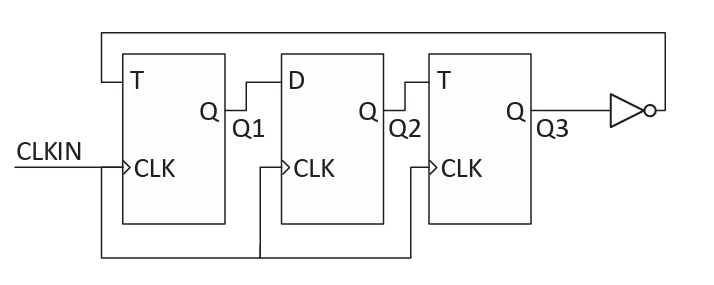
Which one of the given values of (Q1, Q2, Q3) can NEVER be obtained with this digital circuit?
- A.
(0, 0, 1)
- B.
(1, 0, 0)
- C.
(1, 0, 1)
- D.
(1, 1, 1)
Attempted by 131 students.
Show answer & explanation
Correct answer: A
Key idea: track how the D stage copies Q1 on each clock and how the T stages toggle only when their T input is 1. Use one or two clock steps to see which tuples are reachable.
Start: (Q1, Q2, Q3) = (0, 1, 1).
One clock pulse: D captures Q1 (so Q2+ = 0) while the two T flip-flops toggle or hold depending on the T input. This produces (1, 0, 0) in the next state (so (1, 0, 0) is reachable).
Subsequent pulses: by following the same rule (Q2 always takes the prior Q1, and the T-flops toggle only when their T input is 1), other listed states such as (1, 0, 1) and (1, 1, 1) can be realized through appropriate sequences of toggles and copies.
Why (0, 0, 1) cannot occur: the interactions above prevent having Q1 = 0 and Q2 = 0 at a time when Q3 = 1 in any clocked state reachable from the start. From the start, the D stage always copies the current Q1 and the T stages’ behavior forces the circuit away from the pattern (0, 0, 1) after the very first updates, so that tuple never appears in the state evolution.
Conclusion: (0, 0, 1) cannot be obtained; the other three given tuples can be produced by the circuit.