Consider the circuit given below which has a four bit binary number b3b2b1b0…
1996
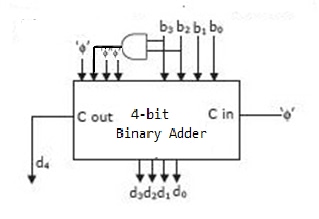
Consider the circuit given below which has a four bit binary number b3b2b1b0 as input and a five bit binary number d4d3d2d1d0 as output. The circuit implements:
- A.
Binary to Hex conversion
- B.
Binary to BCD conversion
- C.
Binary to grey code conversion
- D.
Binary to radix-12 conversion
Attempted by 9 students.
Show answer & explanation
Correct answer: D
Whenever, b2=b3=1, then only 0100 i.e., 4 is added to the given binary number. Let's write all possibilities for b.
Decimal | b₃ | b₂ | b₁ | b₀ |
|---|---|---|---|---|
0 | 0 | 0 | 0 | 0 |
1 | 0 | 0 | 0 | 1 |
2 | 0 | 0 | 1 | 0 |
3 | 0 | 0 | 1 | 1 |
4 | 0 | 1 | 0 | 0 |
5 | 0 | 1 | 0 | 1 |
6 | 0 | 1 | 1 | 0 |
7 | 0 | 1 | 1 | 1 |
8 | 1 | 0 | 0 | 0 |
9 | 1 | 0 | 0 | 1 |
10 | 1 | 0 | 1 | 0 |
11 | 1 | 0 | 1 | 1 |
12 | 1 | 1 | 0 | 0 |
13 | 1 | 1 | 0 | 1 |
14 | 1 | 1 | 1 | 0 |
15 | 1 | 1 | 1 | 1 |
Note that the last 4 combinations (1100, 1101, 1110, 1111) leads to b3 and b2 as 1. So, in these combinations only 0100 will be added.
1100 is 12
1101 is 13
1110 is 14
1111 is 15
in binary unsigned number system.
1100+0100 = 10000.
1101+0100 = 10001 and so on.
This is conversion to radix 12.