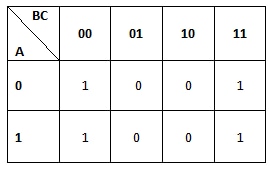
The function represented by the Karnaugh map given below is:
1998
The function represented by the Karnaugh map given below is:

- A.
A.B
- B.
AB+BC+CA
- C.
(B⊕C)'
- D.
A.BC
Attempted by 35 students.
Show answer & explanation
Correct answer: C
Concept: A cell pair in a Karnaugh map can be merged across a variable only when both settings of that variable give the same output for every combination of the remaining variables — the merged term then drops that variable entirely. When the surviving 1-cells are exactly the ones where two variables agree (both 0 or both 1), the resulting two-term sum X'Y' + XY is the XNOR of those variables, written (X⊕Y)'.
Application: Read the map cell by cell:
Row A = 0 and row A = 1 are identical column by column — 1 at BC = 00, 0 at BC = 01, 0 at BC = 10, 1 at BC = 11 — in both rows. Since the output never changes when A flips, A does not appear in the simplified expression.
With A eliminated, the function is 1 exactly at BC = 00 and BC = 11, i.e. whenever B and C hold the same value, and 0 at BC = 01 and BC = 10, whenever they differ.
Writing the two surviving minterms directly: F = B'C' + BC.
B'C' + BC is the standard two-term XNOR pattern X'Y' + XY with X = B, Y = C, so F = (B⊕C)'.
Cross-check: Substitute each column back in: at BC = 01, B⊕C = 1 so (B⊕C)' = 0, matching the map's 0; at BC = 10, B⊕C = 1 so (B⊕C)' = 0 again, matching; at BC = 00 and BC = 11, B⊕C = 0 so (B⊕C)' = 1, matching both 1-cells — and the check holds for both values of A, confirming A truly drops out.
Result: So the function represented by the map is F = (B⊕C)'.