In the Karnaugh map shown below, X denotes a don't care term. What is the…
2008
In the Karnaugh map shown below, X denotes a don't care term. What is the minimal form of the function represented by the Karnaugh map?
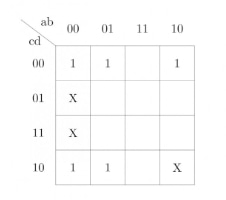
K-Map
- A.
b'd'+a'd'
- B.
a'b'+b'd'+a'b'd'
- C.
b'd'+a'b'd'
- D.
a'b'+b'd'+a'd'
Attempted by 264 students.
Show answer & explanation
Correct answer: A
Solution: derive the minimal expression from the Karnaugh map by forming largest possible groups (including don't-cares).
Step 1: K-map layout and useful observation
Rows correspond to cd in order 00, 01, 11, 10; columns correspond to ab in order 00, 01, 11, 10.
The rows with d = 0 are the top and bottom rows (cd = 00 and cd = 10). Those rows contain the 1s and some don't-cares that let us form larger groups.
Step 2: Form groups using don't-cares to maximize grouping
Group 1: Make a 2x2 block that covers the two rows with d = 0 and the two columns where b = 0 (ab = 00 and ab = 10). This block yields the product term b'd' (b = 0 and d = 0).
Group 2: Make a 2x2 block that covers the two rows with d = 0 and the two columns where a = 0 (ab = 00 and ab = 01). This block yields the product term a'd' (a = 0 and d = 0).
Step 3: Combine the product terms
The minimal sum-of-products is b'd' + a'd'.
You can factor the result as d'(a' + b'), but the minimal SOP form is b'd' + a'd'.
Why this is minimal: each term has two literals and the two terms are necessary to cover all 1-cells (they cannot be combined into a single fewer-literal term without leaving some required 1s uncovered).
A video solution is available for this question — log in and enroll to watch it.