The literal count of a boolean expression is the sum of the number of times…

2003

The literal count of a boolean expression is the sum of the number of times each literal appears in the expression. For example, the literal count of (xy + xz') is 4. What are the minimum possible literal counts of the product-of-sum and sum-of-product representations respectively of the function given by the following Karnaugh map ? Here, X denotes "don't care"
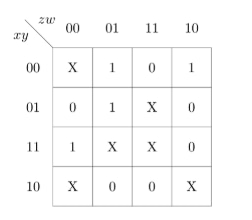
image.png

  1. A.

    (11, 9)

  2. B.

    (9, 13)

  3. C.

    (9, 8)

  4. D.

    (11, 11)

Attempted by 102 students.

Show answer & explanation

Correct answer: C

Solution outline:

  • Identify minterms (1s) and don’t-cares (X) from the K-map:

    • Minterms (1s): indices 1, 2, 5, 12

    • Don’t-cares (X): indices 0, 7, 8, 10, 13, 15

    • Zeros (complement minterms): indices 3, 4, 6, 9, 11, 14

Minimum sum-of-products (SOP) — cover the 1s, using don’t-cares where helpful:

  • Group 1: cells at indices 1 and 5 (column zw = 01, rows xy = 00 and 01). This 2-cell group yields product term x' z' w (3 literals).

  • Group 2: cells at indices 2 and 10 (column zw = 10, rows xy = 00 and 10). Using the don’t-care at 10 allows this 2-cell group, producing product term y' z w' (3 literals).

  • Group 3: cells at indices 12 and 8 (column zw = 00, rows xy = 11 and 10). Using the don’t-care at 8 allows this 2-cell group, producing product term x z' w' (3 literals).

These three product terms cover all required minterms. Literal count for SOP = 3 + 3 + 3 = 9.

Minimum product-of-sums (POS) — cover the zeros (complement), using don’t-cares as zeros where helpful:

  • Group A: Column zw = 11 contains indices 3 (0), 7 (X), 15 (X), and 11 (0). Treat the don’t-cares as zeros to form a 4-cell zero-group. This yields a 2-literal sum term (z' + w').

  • Group B: Pair zeros at indices 6 and 14 (both in column zw = 10, rows xy = 01 and 11). This 2-cell zero-group yields a 3-literal sum term.

  • Group C: Pair zeros at indices 9 and 11 (row xy = 10, columns zw = 01 and 11). Using the 4-cell grouping earlier does not cover index 9, so pair 9 with 11 (or use the don’t-care at 13 if needed). This pair yields a 3-literal sum term.

  • Group D: Pair zero at index 4 with the don’t-care at index 0 to form a 2-cell zero-group, yielding a 3-literal sum term.

Literal count for POS = 2 (from the 4-cell group) + 3 + 3 + 3 = 11.

Final result (minimum literal counts): product-of-sums = 11, sum-of-products = 9.

A video solution is available for this question — log in and enroll to watch it.

Explore the full course: Gate Guidance By Sanchit Sir